Get Full Government Meeting Transcripts, Videos, & Alerts Forever!
Get email alerts on the Land Use Classification topic
No spam. Unsubscribe anytime.
Planning commission begins overhaul of land-use table; staff to return with consolidated draft
Summary
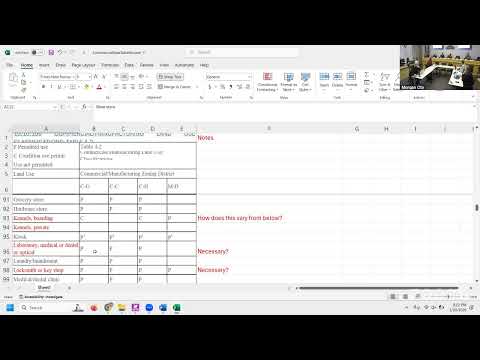
Commissioners reviewed a council-ranked land-use priority list and began a broad review of the land-use classification table and definitions, agreeing to remove uses that conflict with state/federal law and to have staff return with a consolidated draft for staged review.
Morgan City's Planning Commission began a multi-step review of the city's land-use classification table during its Jan. 20 meeting, reviewing council priorities and asking staff to return with a consolidated, staged draft.
Jake, who presents planning staff recommendations, summarized the council's priorities: "Number 1 is land use table, which will actually start tonight," followed by ordinance updates to match the general plan (including the downtown ordinance), a review of the RM-15 zone, smaller single-family lots and notification-process improvements. He said the general plan review is in progress and staff plans a public open house in March.
The commission discussed the size and structure of the existing use table and whether to keep detailed enumerations or consolidate uses under broader definitions such as "retail" or "community use." Commissioners and staff flagged specific items for immediate attention: removing age- or disability-specific listings that conflict with federal fair-housing protections, consolidating duplicate entries (for example multiple elderly- or residential-facility listings), and clarifying how residential uses are treated in commercial zones.
Gary advised the commission to remove any uses that are inconsistent with state or federal law (citing Fair Housing protections) and to prioritize correcting illegal references first. He noted that state changes since 2007 mean some uses listed in the code are now problematic and should be cleaned up.
Staff described missing or underrepresented categories to consider adding or clarifying, including co-working / shared-office spaces, flex/maker spaces, commercial kitchens for small food producers, limited fulfillment/last-mile facilities, and EV charging as a principal use. Commissioners asked staff to present the code visually by zone and to return with a draft that groups similar uses under definitions so staff and the public can more easily process applications.
The commission agreed on a staged approach: staff will remove items that conflict with state or federal law and then return with a consolidated draft focusing on the most debated 10'20 entries per meeting to make progress without overwhelming the commission. The meeting adjourned after these items were discussed and a short break earlier in the evening.
A procedural motion earlier in the regular session approved three sets of pending minutes from October through December 2025 and was recorded as approved.