Get Full Government Meeting Transcripts, Videos, & Alerts Forever!
Get email alerts on the Duke Street Plan topic
No spam. Unsubscribe anytime.
Alexandria staff present draft Duke Street corridor plan; commission urges clarity on small businesses, displacement and the Civic campus
Summary
Planning staff outlined a large-scale Duke Street corridor small-area plan, citing scale (3.5 miles, large redevelopment opportunity sites), outreach findings and draft principles; commissioners pressed for clearer implementation steps on small-area plan overlaps, small-business retention and the 55-acre Civic and City Campus.
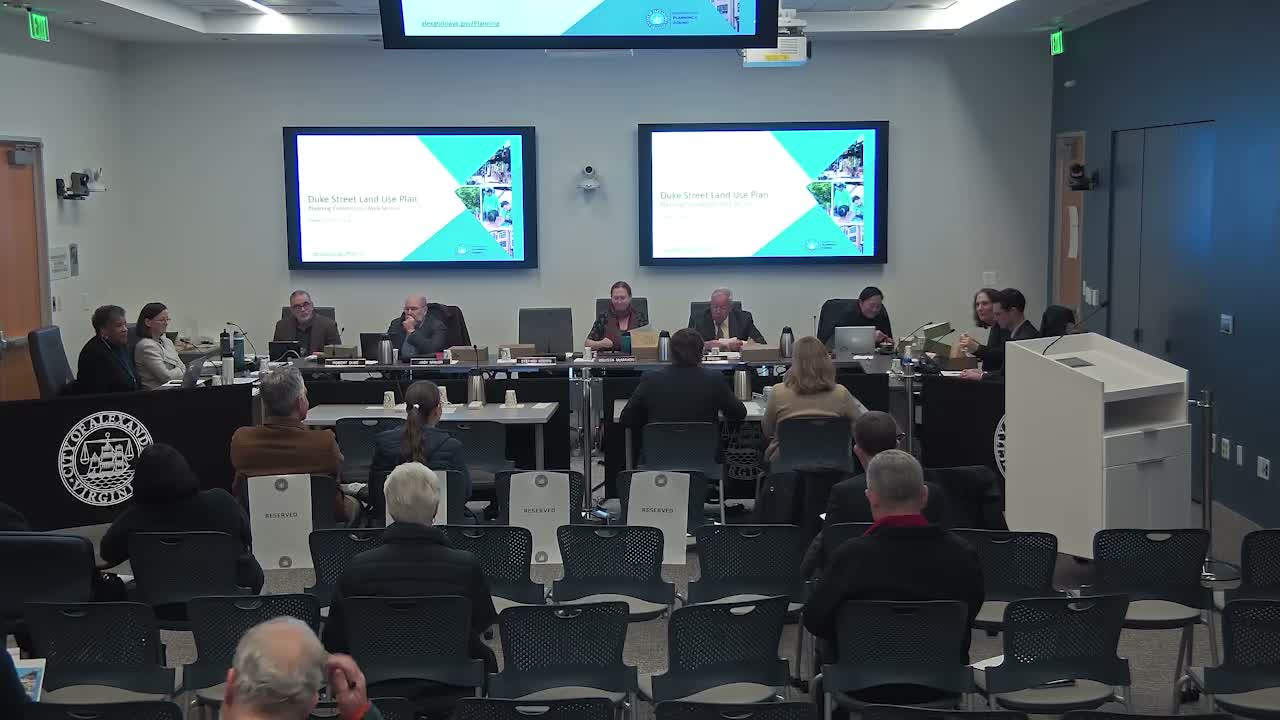
Alexandria planning staff presented draft concepts for a Duke Street corridor small-area plan to the Planning Commission in a work session, asking commissioners to weigh in on priorities, implementation sequencing and how to protect neighborhood-serving businesses.
Staff emphasized the corridor’s scale and influence on citywide growth, saying the area spans about 3.5 miles and includes a large amount of impervious surface that will shape redevelopment and infrastructure needs. Carrie Beach of Neighborhood Planning, Planning and Zoning said the formal process began in June 2025 and that staff expect to draft detailed concepts this year, return to council in a work session and hold a public hearing roughly one year after the launch. "We formally launched in June 2025," Beach said, summarizing the project timeline and the next public engagement steps.
The presentation summarized community engagement results: the plan area contains about 15% of the city’s population, roughly 61% of housing in the area is rental, there are about 300 businesses in the corridor, and an early online poll drew 77 business-owner responses. Staff said outreach repeatedly surfaced safety and walkability concerns, a desire to make the corridor feel more cohesive, and worries about rising rents and potential loss of neighborhood-serving retailers.
Staff described three core types of places in the draft: opportunity sites (about 90 acres of mostly lower-density commercial or surface parking parcels targeted for redevelopment), affordability-and-growth areas (including Fox Chase, which staff estimated at about 1,500 units), and a Civic and City Campus — a roughly 55-acre city-owned cluster of facilities and yards. On the Civic and City Campus, staff said some areas will need to remain operational (vehicle storage, salt storage, other functional uses) but asked whether portions could be more publicly accessible or have a stronger civic presence.
Commissioners pressed staff for specifics. Commissioner Brown asked how the corridor plan would interact with existing small-area plans that overlap Duke Street and recommended staff clearly identify which existing plan controls when recommendations overlap. "It would be helpful for you to make clear, effectively which one of those plans controls with regard to any recommendations that overlap," Commissioner Brown said.
Commissioner Dube asked about coordination with the Duke Street in Motion and streetscape projects; staff said the Duke Street in Motion improvements approved by council are not being revisited but that streetscape details and transit stop locations are being coordinated with departments, including Transportation and Environmental Services. Commissioners also asked staff to analyze phasing — short-, mid- and long-term improvements — so the plan can identify early safety priorities and a sequence for implementation.
Several commissioners raised small-business retention and displacement risks. Commissioner Manor asked whether staff had considered interim relocation or other tools to keep small businesses in the corridor during redevelopment; staff said that risk should be addressed in the plan and noted retail rents in some centers already approach new-construction levels, meaning some businesses might be able to transition into new space, while others would need protections or strategies to remain.
On next steps staff reiterated public workshops in January, a city council work session scheduled for January 27 and a tentative February 25 meeting, and invited commissioners and stakeholders to submit follow-up comments as staff begins drafting detailed concepts.
No formal action or vote occurred during the work session; staff requested guidance and will return with more detailed drawings and implementation recommendations.