
Council backs letters of intent for two local affordable housing projects, including Habitat Willow Street and Odd Fellows Lodge plan
Get AI-powered insights, summaries, and transcripts
Subscribe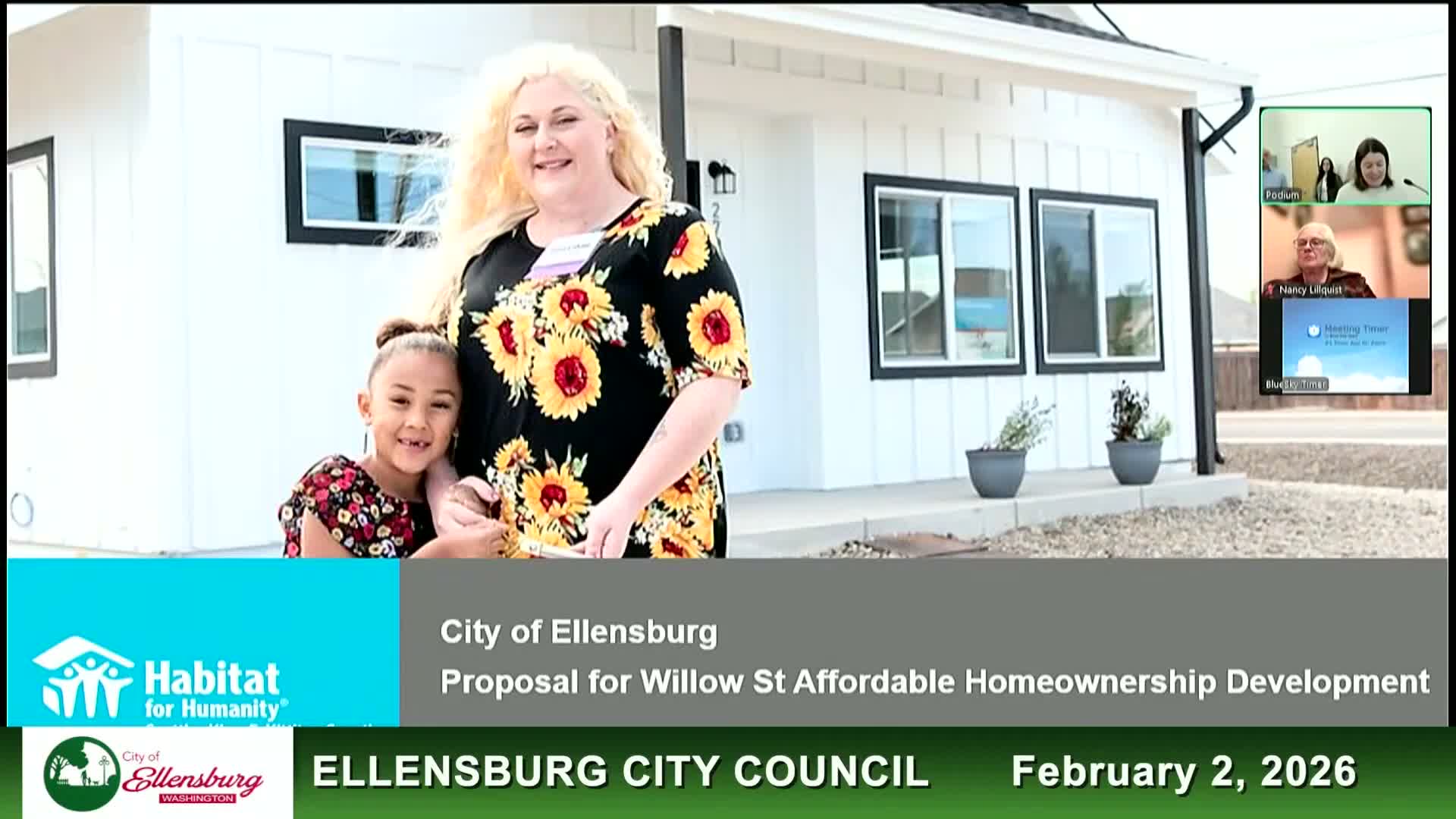
Summary
The council authorized letters of intent and directed staff to develop agreements for Habitat for Humanity’s three-unit Willow Street project ($1.1M request) and Odd Fellows Lodge No. 20’s 24-unit rental proposal ($1.2M request), citing permanent affordability mechanisms and a mix of funding including a $1M CHIP award for the Odd Fellows site.
On Feb. 2 the Ellensburg City Council authorized the mayor to sign letters of intent and directed staff to develop affordable housing agreements for two proposed projects: Habitat for Humanity’s Willow Street development and the Odd Fellows Lodge No. 20 housing project.
Habitat presentation: Lily Fry, housing program manager, and Marie Spangler of Habitat for Humanity described the Willow Street proposal for three two-bedroom homes on a single lot at 510 South Willow. Habitat requested $1,100,000 from the city’s affordable housing sales tax fund (approximately $367,000 per unit). The homes would be permanently affordable using a community land trust and a ground-lease model, restricted to households at or below 60% of area median income (AMI). Habitat said the project could be completed by August 2027 if funding is in place; staff and council discussed per-unit costs and inclusion of acquisition costs in the budget.
Odd Fellows presentation: The Odd Fellows Lodge and partner Office of Rural and Farmworker Housing presented a phased plan on roughly 10 acres of underused cemetery land to construct 24 rental units (12 one-bedroom, 12 two-bedroom), reserving units for veterans and households at or below 50% AMI. The project requested $1,200,000 from the sales tax fund (about $50,000 per unit) and reported a recent $1,000,000 CHIP grant award; project sponsors said they remain in pursuit of additional funding including possible direct appropriations.
Council discussion centered on cost per unit, funding stacks (including prevailing-wage considerations), accessibility of ground-floor units and scoring/prioritization of target populations. For Willow Street staff and Habitat representatives said the requested amount would fully fund that project. For the Odd Fellows project, presenters said the CHIP grant plus potential state funding would help close funding gaps and that the parcel’s donated land removes a major acquisition cost barrier.
Both motions to authorize letters of intent and direct staff to prepare agreements passed; a number of councilmembers abstained from votes where conflicts were declared and staff confirmed a quorum for passage.
Next steps: staff will draft affordable-housing agreements, return them to council for review and continue coordination with applicants on timelines and additional funding sources.