Get Full Government Meeting Transcripts, Videos, & Alerts Forever!
Get email alerts on the Solar Ordinance topic
No spam. Unsubscribe anytime.
Williamsburg County advances amended solar‑facility rules after public hearings
Summary
After public comment from residents and conservation groups, the council approved language at second reading that tightens buffers, adopts decommissioning standards and reduces the county acreage reserve for solar projects from 3.5% to 2%.
County Supervisor (name not specified) and the Williamsburg County Council advanced substantial amendments to a proposed solar‑energy ordinance (ordinance 2024‑05) at second reading on April 16 after an evening of public comment and attorney‑proposed revisions.
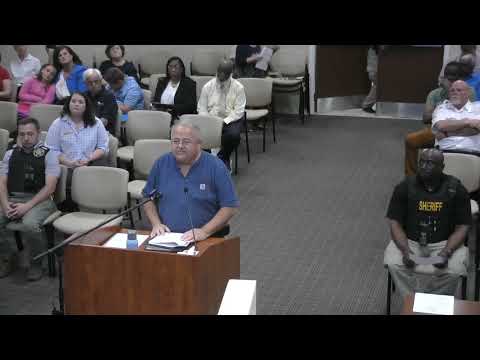
Several residents and advocates urged stronger environmental and community protections during the public‑hearing portion of the meeting. Becky Ryan, North Coast Office Director for the Coastal Conservation League, commended the draft and asked the council to “explicitly encompass both federally jurisdictional and all other wetlands,” to add a 50‑foot vegetated buffer and to encourage native pollinator seed mixes for ground cover. Thomas Dukes, who has ties to the county fire department, asked that companies supply training to local first responders and asked that decommissioning guarantees not be capped at $50,000. Cheryl Lane and Faith Truesdale questioned the ordinance’s 3.5% acreage ceiling for solar projects (3.5% equates to roughly 21,000 acres in the county) and urged larger setbacks from residences and clearer, stronger vegetative buffers.
County Attorney Shurer read a package of amendments the council adopted for second reading. Shurer said the ordinance’s definition of a solar facility was broadened, setbacks to nearest residences and churches were set at 300 feet (reducible by adjacent owner agreement), and that permanent facilities would be screened from public rights of way and from residences or churches within 500 feet with a vegetative buffer plus fence or wall. The ordinance requires anti‑reflective coatings and moves FAA notification and some glare‑study requirements into the site‑plan approval process. Shurer said, “any development within wetlands should be approved only with the blessing of the Army Corps of Engineers or DHEC” and must be raised above the 100‑year flood elevation where required.
The county also tightened decommissioning and restoration standards. Attorney Shurer explained the landowner and successors must acknowledge responsibility for decommissioning; a licensed South Carolina professional engineer must provide decommissioning cost estimates that are updated every five years and the required financial assurance (bond or similar) must be adjusted accordingly. Restoration must include removal of panels, permanent foundations and other infrastructure, with excavation and borings backfilled and compacted. She told council that cleanup timelines will be six months for projects under 500 acres and one year for projects over 500 acres.
On a motion by Councilman McKnight to include the attorney’s amendments, the council voted by voice to carry the ordinance forward at second reading with those changes.
Council members and public speakers said they expect the amended ordinance text to be posted to the county website by 5 p.m. the following day so residents and landowners can review the exact language before further readings.