
Athens hears pitch to buy AEP streetlights, presenters say ownership could cut costs and speed repairs
Get AI-powered insights, summaries, and transcripts
Subscribe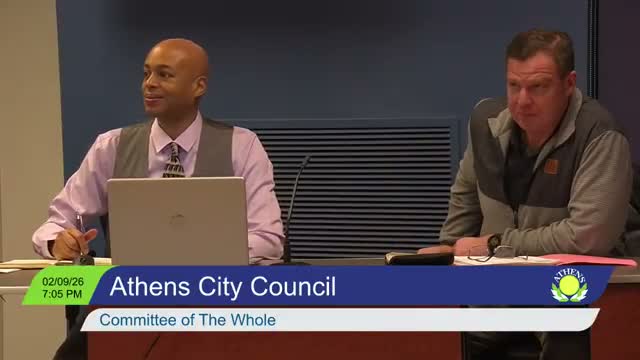
Summary
A consultant from Tanko/Tango Lighting told the Athens City Council committee that buying approximately 653 American Electric Power fixtures could reduce annual operating costs, speed repairs, and unlock smart‑city options; city staff said acquisition would require negotiation of franchise terms and later appropriation decisions.
Jason Tango, founder of Tanko/Tango Lighting, told a Committee of the Whole on Feb. 9 that taking ownership of the city’s streetlights could improve public safety, shorten repair times and lower long‑term operating costs.
Tango said an audit showed about two‑thirds of Athens’ streetlights are owned by American Electric Power (AEP) under unmetered lease arrangements and that the city owns roughly 459 fixtures. He presented a year‑one estimate that would reduce the city’s annual streetlighting operating cost from roughly $157,000 to about $93,822 while noting an estimated capital payment near $491,000. Tango said that acquisition would produce an estimated $2,000,000 in savings over 20 years and a roughly 6.6‑year return on investment.
Director Stone (city administration) said the presentation was exploratory and that the administration does not plan to seek an appropriation immediately. Stone said the city’s electricians already maintain city‑owned fixtures and that the AEP‑owned fixtures (about 653) would likely be maintained under a contract with a vendor if acquired. Stone said initial work could be done under existing budget authority up to about $50,000 to test feasibility before the administration returns to council to request the full appropriation that would be required to complete an acquisition.
Council members asked practical and legal questions. Members pressed whether taking ownership would require new maintenance staff; Stone said most maintenance would be contracted because many leased fixtures are attached to higher‑voltage circuits. On whether AEP would sell, Stone and the presenter described two possible paths: using the city’s home‑rule authority or negotiating through the city’s franchise agreement, which the presenters said is currently open for renegotiation. They also cited state precedent as supportive of municipal acquisition while acknowledging AEP is likely to resist a sale.
Residents who spoke during public comment echoed both support and practical questions. Rob Dilich, who recalled a similar discussion in 2019, noted that AEP has since converted many fixtures to LED and asked whether the city would need to replace poles or fixtures and whether continued use of AEP poles would carry costs; the presenters said poles would remain in the right of way and that joint pole agreements would cover future attachments.
No formal motion or vote on acquiring lights was taken; council members instructed staff to continue due diligence and return with ordinance language and cost details if negotiations progress.
The council’s next step, as described by the administration, would be to prepare a complete acquisition cost proposal and, if warranted, seek appropriation and, possibly, short‑term borrowing for the capital payment.