
Soil microbiome profiling can link tiny traces to locations, researcher says
Get AI-powered insights, summaries, and transcripts
Subscribe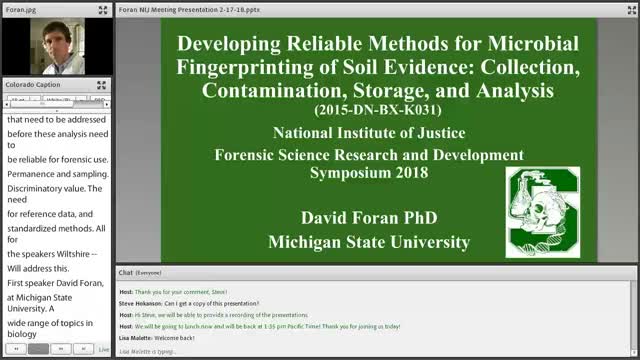
Summary
At the NIJ Forensic Science R&D Symposium, David Foran of Michigan State University reported that bacterial profiling of soil can produce usable 'fingerprints' from trace amounts (as little as about 1 milligram), that surface samples are usually most informative, and that wet blood or wet storage can substantially alter results.
David Foran, director of the forensic science graduate program at Michigan State University, told an NIJ symposium audience that bacterial profiling of soil shows promise as a forensic 'fingerprint' and can produce usable results from very small traces. "Trace amounts of soil can be profiled down to 1 milligram," Foran said, reporting lab results from a multi-year NIJ-funded project.
Foran described the laboratory approach used by his team: sequencing conserved ribosomal gene regions and analyzing variable regions to characterize bacterial communities in a soil sample, producing hundreds of thousands of sequences per sample and enabling statistical classification. He said visualization tools such as bacterial abundance charts and nonmetric multidimensional scaling (NMDS) help juries see how an evidence sample clusters with known reference samples, and supervised classifiers (bagged trees/random forest) provide objective matches.
The research tested several practical concerns for forensic use. In experiments across diverse habitats — dirt roads, fields, deciduous and coniferous woods, and lake beaches — Foran reported the method could distinguish habitats and even nearby, similar woodlots. Small spatial offsets in sampling (for example, sampling five feet away from a known point) typically did not cause misclassification. Seasonal changes were detectable but usually did not cause a sample to be assigned to a different habitat.
Foran said the team probed sensitivity by reducing input to the DNA extraction down from the kit recommendation (about 250 milligrams) to as little as 1 milligram and found that profiles remained visually similar and usable, though low-input samples sometimes require adjustments such as adding more PCR input DNA.
The team also tested ex situ aging — how a soil sample changes after being removed from its original habitat and left on an item over days to months. Foran reported consistent directional changes in relative abundances (for example, relative increases in actinobacteria and bacilli and decreases in sphingobacteria and acidobacteria) so that aged evidence will drift away from fresh knowns in NMDS space. "They're not becoming more like a different habitat," he said; instead, samples become less like their original state, which the team believes can be accounted for if labs age comparator ('known') samples under similar conditions.
Temperature and storage mattered: Foran said changes occur at room temperature, slow at refrigeration (about 4°C), and largely stop at freezing temperatures, so freezing can 'lock' a sample's profile. Still, he warned that asking a suspect to freeze their shoes is impractical, so labs must consider aging effects when collecting and preparing known samples for comparison.
Depth and mixtures were examined by coring to as deep as 60 inches at study sites. Foran reported clear compositional changes with depth, but when surface soil is mixed with deeper material, the surface bacteria typically dominate the combined profile. As a result, shallow samples (roughly 2–3 inches) often provide representative surface profiles and deep coring is not usually necessary for the kinds of comparisons the team tested.
The researchers evaluated exogenous factors such as clothing and skin microbiomes. Volunteers wore clean T-shirts for 24 hours, then soil was placed on the shirts; Foran said the shirts carried enough soil bacterial signal that sampled shirts clustered with the correct habitat and that the human skin microbiome had relatively little influence on the soil signal.
By contrast, blood had a strong effect. Foran described experiments mixing pig blood and soil at several ratios and storing samples dry and wet. When blood was present in substantial amounts and remained wet, bacteria that thrive on blood grew and the resulting profiles diverged markedly from ordinary aged soils. "The blood, if sufficient and wet, has a big influence," Foran said, and he warned that wet storage or prolonged wetness can mislead comparisons.
Foran summarized practical implications: trace quantities of soil can yield useful bacterial profiles, temporal and storage effects exist but can be modeled or mitigated by handling and comparator preparation, shallow surface sampling usually suffices, skin microbiome contamination is minor, and wet blood or wet storage poses a substantial confounder. He noted the team's paper on temporal changes was accepted this year in the Journal of Forensic Sciences and acknowledged collaborators and funders, including the National Institute of Justice (NIJ).