
Pacifica council reaffirms sanctuary status and backs offshore reef feasibility study
Get AI-powered insights, summaries, and transcripts
Subscribe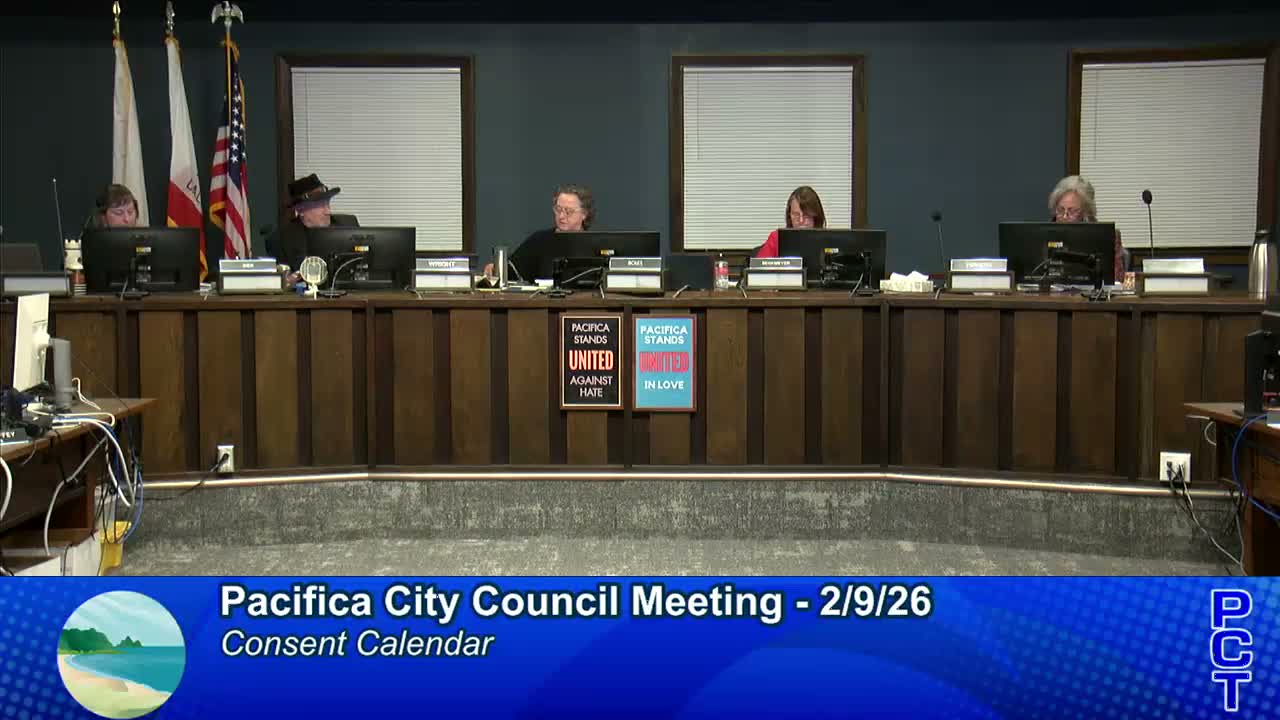
Summary
Council approved the consent calendar unanimously, including a resolution reaffirming Pacifica as a sanctuary city and authorization to sign a $150,000 grant application with '1 Shoreline' (with a potential $75,000 Dept. of Boating & Waterways share) to study offshore reef feasibility and coastal resilience modeling with UC Santa Cruz partners.
Pacifica’s City Council approved its consent calendar unanimously, a package that included a formal reaffirmation of the city’s sanctuary policy and authorization to pursue a coastal resiliency feasibility study.
On the sanctuary resolution, the council adopted language reaffirming Pacifica’s ordinance (Pacifica Municipal Code referencing sanctuary policy) that city services are available to all residents regardless of immigration status, citing the California Values Act (SB 54). The resolution expressed concern about recent federal immigration enforcement actions and called for accountability, transparency, and protection of due process. It asks the city clerk to send certified copies to federal and state officials and civil-rights organizations and directs publication and posting per law.
Also on consent, the council authorized the city to sign a $150,000 grant application with "1 Shoreline" for a feasibility study of an offshore reef concept and regional modeling led by UC Santa Cruz scientists and engineers. Mayor Bowles described the effort as a county-partnership approach to coastal adaptation; staff said the application seeks $75,000 from the California Department of Boating and Waterways if approved, with other regional funding possibilities under consideration. The item was presented as a feasibility study only; staff said Pacifica is not being asked for funds at this time.
A number of public commenters supported the reef feasibility work, urged use of best-available science, and praised the sanctuary reaffirmation. Several members of the public used the general comment period to press the council on short-term rental enforcement and other local issues; staff said reports and prior data are available and said enforcement details on active matters could not be discussed in open session. The consent calendar passed on a unanimous voice vote.