
Farm leader warns: state and federal rules — from APR recycling to overtime — are reshaping Livingston County agriculture
Get AI-powered insights, summaries, and transcripts
Subscribe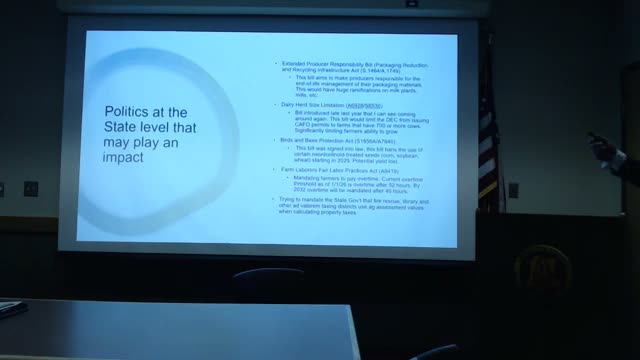
Summary
At a Livingston County forum a Noblehurst Farms representative outlined how proposed and enacted policies — including an extended producer responsibility bill, the Birds and Bees seed restrictions, and a phased overtime rule lowering threshold to 40 hours by 2032 — could raise costs and affect farm competitiveness, while federal action on immigration and tariffs remains a top lobbying focus.
At a public forum in Livingston County a presenter speaking for Noblehurst Farms and the local Farm Bureau detailed a string of policy developments he said will materially affect local farmers, particularly dairies.
On state policy the presenter flagged an extended producer responsibility measure (referred to as the "APR" bill) that would make producers responsible for end‑of‑life management of products they sell. "This bill really aims to make producers responsible for the end of life management of the products that they sell," he said, and cautioned the current drafts contain few agriculture‑specific protections for milk plants and feed mills.
He also noted a recently enacted measure he called the Birds and Bees Protection Act, which includes restrictions on neonicotinoid‑treated seeds and will limit certain seed uses beginning in the timeframe the presenter cited (discussed as affecting planting practices starting in 2029). The presenter warned the rule could depress yields where affected seed treatments are no longer available.
The state s Farm Laborers Fair Labor Practices Act was described as the most immediate cost pressure: the presenter said the overtime threshold was phased down from 60 hours and will continue to fall by four hours every two years, leading to a 40‑hour threshold by 2032. "By 2032, we will be down to a 40 hour week where farmers are then mandated to pay overtime," he said, calling the change likely to increase labor costs substantially and complicate staffing decisions given the skill demands of farm work.
At the federal level the presenter identified immigration and tariffs as top advocacy priorities for farm groups. He said congressional agriculture committee leaders had acknowledged the workforce problem and that his lobbying efforts were focused on securing a legal workforce for agriculture.
He also cited a recent federal policy win: passage of the Whole Milk for Healthy Kids Act, which restores whole milk as an option in some school programs. The presenter noted additional private and public investment in processing capacity — more than $3 billion reported in New York state — as a positive offset for local farmers.
Participants asked for clarity on authority and next steps; Dan Kai of the USDA Natural Resource Conservation Service explained easement funding and partnerships. The presenter encouraged local officials and residents to engage with lawmakers over tax credits (overtime retention tax credit, investment tax credit) and siting rules for renewable projects to balance energy expansion with farmland protection.
Next steps noted in the session: continued outreach to Albany and Washington by farm advocates, and follow‑up conversations on land‑protection tools and infrastructure constraints such as substation capacity that determine which renewable projects can operate locally.