Finance committee reviews IU services, contracts and budget outlook; charter tuition pressure highlighted
Loading...
Summary
The Finance Committee received a Bucks County Intermediate Unit presentation showing Pennridge's 2026-27 programs-and-services contribution at $82,580. Administrators reviewed contracts (Microsoft renewal, GASB 75 valuation, Rubrik backup) and described fiscal 2024-25 variances driven by IU services, substitutes and cyber charter tuition, which added pressure to the general fund.
Dr. Haller of the Bucks County Intermediate Unit (Bucks IU) told the Finance Committee the IU's programs-and-services budget for 2026-27 is roughly $2.15 million; Pennridge's share is $82,580, an increase of $795 from the prior year. Haller outlined services that Pennridge uses through the IU, including leadership development, mobile fab lab visits and instructional coaching, and reviewed the IU's approval timeline: district approvals through Feb. 28 and final IU board approval April 21.
The business manager reviewed a slate of contracts and vendor renewals on this month's list. Highlights include a Microsoft services agreement prorated at $50,218 for the current contract year and estimated at $85,000 annually thereafter; a GASB 75 actuarial valuation contract with Conrad Siegel to meet audit requirements; and a change to a Chester County IU-provided Rubrik data-backup service, which staff proposed as a cost-saving move compared with the prior vendor. A board member asked whether the Rubrik contract imposes a 20-terabyte minimum; administration later confirmed there is a 20 TB minimum and no explicit cap and that a matching cloud host is provided by the IU.
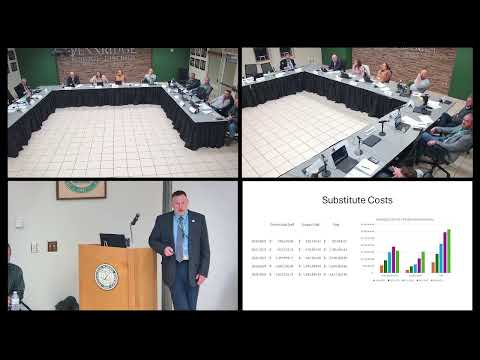
On the district budget, administration summarized 2024-25 final results: revenues totaled about $158.6 million (roughly $546,000 under budget) while expenditures were about $161.9 million (roughly $2.7 million over budget), producing a $3.3 million deficit for the year. Drivers of the expenditure variance included higher professional services (notably IU educational services), substitute staffing, and increased charter/cyber charter tuition costs tied to students who left the district.
Board members discussed cyber charter tuition and district-run cyber programming. Administration said recent outreach and local cyber-program options helped return some students, and the district expects about $245,000 in relief from recent state-level charter reforms in the governor's budget. Committee members asked for additional analysis during March budget deliberations, including scenarios of transferring less than the projected capital-transfer amount to the capital projects fund and the effect on summer project schedules.
No finance vote was taken; the committee scheduled the next finance meeting for March 9 and offered one-on-one follow-ups with board members to review details.