Get Full Government Meeting Transcripts, Videos, & Alerts Forever!
Get email alerts on the Child Health Services topic
No spam. Unsubscribe anytime.
Adams County parent credits birth‑to‑3 and CLTS with helping medically fragile daughter reach milestones
Summary
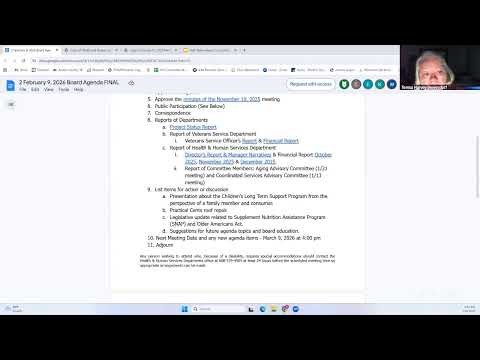
At a Health & Human Services committee meeting, Lindsey Ryan described how Adams County’s birth‑to‑3 and Children’s Long‑Term Support (CLTS) services provided timely access to therapy and adaptive equipment that helped her daughter Faith recover mobility and participate in school and community programs.
Lindsey Ryan told the Adams County Health & Human Services committee that her daughter Faith was born at 23 weeks and five days and spent roughly 14 months in neonatal care, including tracheostomy and ventilator support. Ryan said early, local services were critical to Faith’s progress.
"We did not have to go on a wait list for birth to 3 or CLTS, and we're very grateful for that," Ryan said, describing immediate enrollment in county early‑intervention services when Faith came home in April 2021. She credited physical therapy, speech and occupational therapy, and adaptive equipment provided through county programs and CLTS for helping Faith develop core strength and mobility.
Ryan listed specific supports that aided her daughter’s recovery: a stander, a gait trainer and a reverse walker that helped Faith learn to stand and walk; specialized adaptive shoes and SMO ankle braces; sensory supports such as a water and sand table and a swing; private adaptive swim lessons and dance classes; and music therapy through Life in Harmony. Ryan also said CLTS supplied g‑tube–friendly clothing and, more recently, a laptop to allow remote attendance at therapy and school appointments when respiratory illness made travel risky.
The presentation included personal details about Faith’s early medical treatment and long hospital stay, and described how incremental gains — learning to tolerate holding hands, building core strength, and mastering assistive devices — led to functional milestones: walking, talking and keeping pace with peers in school.
Kelly and committee members thanked Ryan and her family for the "moving presentation," and committee members noted the local examples as evidence of the real‑world impact of county early‑intervention programs.
Ryan’s remarks underscore practical outcomes county staff said they want to preserve as staffing and funding pressures affect service delivery.
The committee had no formal action tied to the presentation; staff and members suggested keeping similar items on future agendas for awareness and outreach.