
Lakeville continues Simmons Hill 40B hearing after developer revises plan; tribes and residents raise water, traffic and cultural concerns
Get AI-powered insights, summaries, and transcripts
Subscribe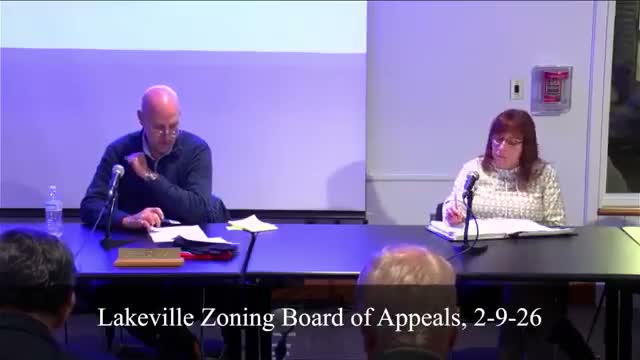
Summary
At a Feb. 9 hearing, Simmons Hill LLC presented a revised 40B plan—now proposing roughly 199 single-family homes with at least 50 affordable units—while tribal representatives and neighbors raised concerns about burial sites, groundwater, septic systems, blasting and traffic; the board continued the hearing to April 13 for additional studies and engineering.
The Lakeville zoning board on Feb. 9 voted to continue its hearing on Simmons Hill LLC’s application under Massachusetts General Laws Chapter 40B after the developer presented a revised plan and residents, including tribal representatives, pressed for more information on water supply, archaeological resources, traffic and blasting risks.
The board read into the record a memo from Lakeville Fire Chief Michael P. O’Brien warning that the site “lacks an approved static water source capable of meeting the required fire flow” under applicable fire code requirements and that, without an engineered water supply, the fire department could not approve occupancy or issue certain certificates under Mass. Gen. Laws ch. 148 §26F. The memo, which the chair said was sent to the applicant by certified mail, was noted as unresponded to in the town file.
Robert Mather, representing the applicant, said the developer has revised an earlier concept and now proposes to develop almost the entire 320-acre parcel (leaving an 8.8-acre corner for potential commercial use). Mather described the revised plan as a subdivision of roughly 199 single-family dwellings with a mix of regular and age-restricted lots; he said about 25% of lots (50 units) would be restricted as affordable and that 58 units would be age-restricted. He told the board the average non-age-restricted lots would be about 20,000 square feet (minimum 15,000) while age-restricted lots average about 12,000 square feet, and that roughly 57% of the parcel would remain as open space.
“If we can’t comply with [fire protection requirements], we can’t do the project,” Mather said, stressing that engineering must address the fire-safety and water-supply issues before the project can proceed to permitting.
Traffic was a central focus of questioning. The developer said the revised plan adds a third entrance and exit onto County Street to provide alternative access, and Mather said the team has ordered a new traffic study expected within two weeks. Mohammed Itani, a member of the development team, said the developer’s traffic engineer believes a three-way stop at the nearby intersection may not meet MassDOT thresholds but that the developer would consider adding lanes or other improvements if the town’s traffic reviewer recommends them. Itani also said the developer is willing to “participate” in a broader regional waterline project if the cost and timing were feasible.
Public commenters raised multiple concerns. Daryl Wicksen, identified as a member of the Wampanoag Nation, told the board the area contains burial sites and sacred ceremonial areas and urged the board not to allow disturbance: “Any alteration to this place will be a devastating outcome,” he said. Other tribal and tribal-affiliated commenters, including a deputy Tribal Historic Preservation Officer and a tribal attorney, urged formal federal consultation and a Section 106 cultural-resource review, requested that federally recognized tribes be fully included in field work, and asked for archaeological methods that go beyond a walkover, such as subsurface scanning.
“There are too many concerns to even cover here,” said Karina Silva, a Wampanoag woman and attorney who urged rigorous tribal consultation and noted the site includes wetlands. “This is one of the most culturally significant places for all of the Wampanoag communities,” she said, and said she would request a full Section 106 review.
Neighbors also pressed technical issues: several residents asked for detail on bedrock and blasting risks, possible impacts to foundations, and whether the proposed nine septic systems (the developer said there would be nine systems, each serving roughly 18–19 dwellings) and many individual wells would affect surface and groundwater. One resident asked whether the town or state had reviewed the developer’s plans; the chair and applicant confirmed that the 40B process begins with state-level review by MassHousing and that town boards provide input on local constraints.
The developer told the board it would supplement earlier archaeological studies with additional PAL (Public Archaeological Laboratories) work in areas not previously examined, and said the team would coordinate with the town’s conservation commission and the town’s engineering reviewer. Several public speakers asked the board to ensure tribal representatives and qualified archaeologists could access the property when field conditions permit, and not rely only on limited walkovers.
Following the presentation and an extended public-comment period, a board member moved to continue the hearing to April 13 to allow the applicant to submit the updated traffic study, updated engineered plans, and supplemental archaeological work; the board seconded the motion and the chair announced the motion carried unanimously. The board also approved prior meeting minutes during the session.
What’s next: The developer said it expects to submit the new traffic study within about two weeks and will provide updated engineering and supplemental archaeological reports thereafter. The zoning board scheduled the continued hearing for April 13 and said it would invite both the developer’s and the town’s traffic engineers to appear together to discuss the traffic analysis.
Authorities and documents cited at the hearing included references to Mass. Gen. Laws ch. 40B, applicable 527 CMR fire code provisions, Mass. Gen. Laws ch. 148 §26F (related to certificates of compliance), and prior PAL archaeological reports; the developer referenced MassHousing review and the town’s conservation and engineering review processes.
The hearing record shows substantive outstanding issues—fire protection water supply, formal tribal consultation and archaeological scope, traffic impacts and intersection design, septic/well system details, and potential blasting/ledge impacts—that the board said must be addressed before it can advance permitting.