
Council reviews rules of procedure, debates remote participation and council-initiated actions; schedules options and moves to closed session
Get AI-powered insights, summaries, and transcripts
Subscribe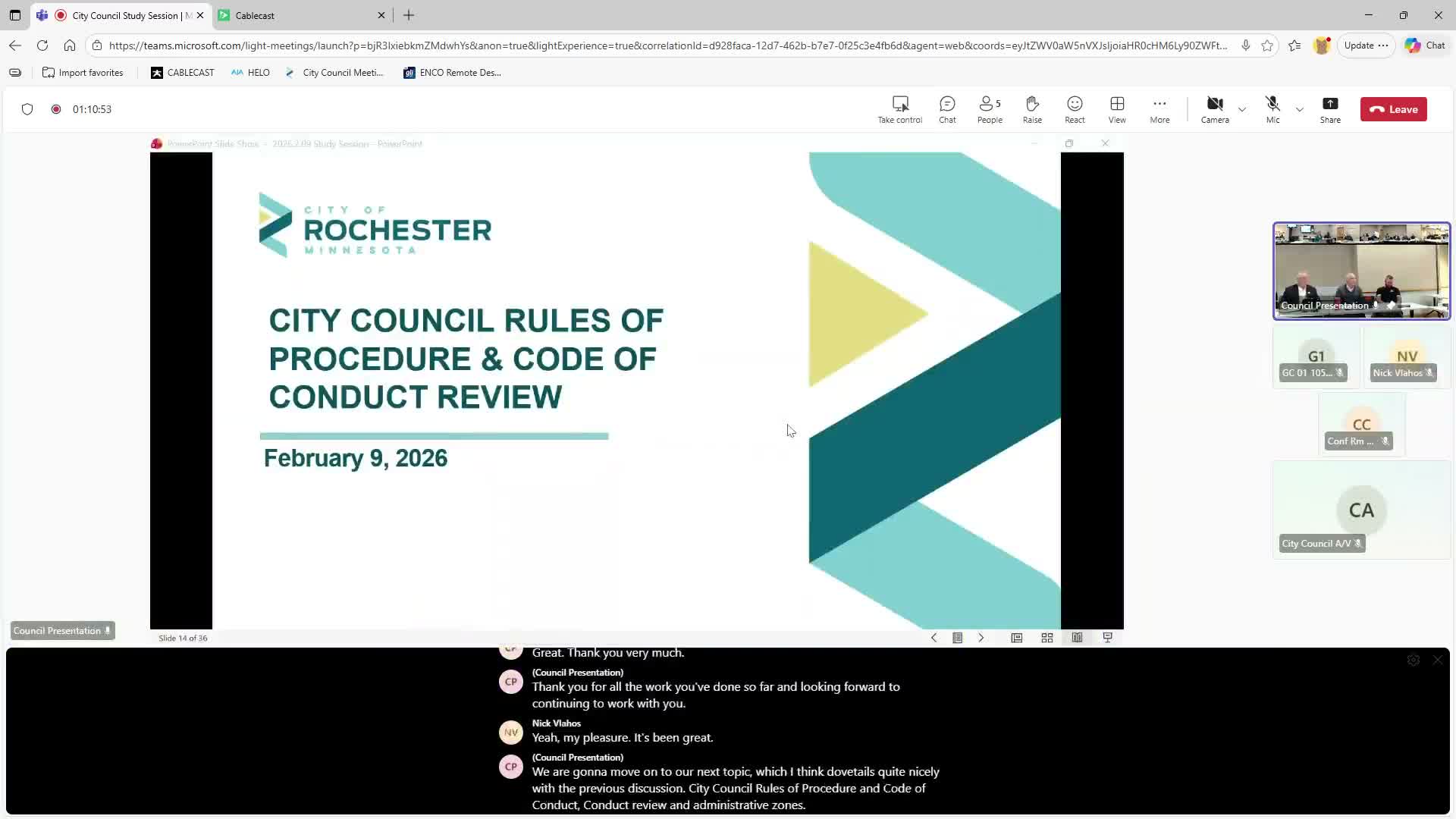
Summary
Council and staff reviewed the rules of procedure and code of conduct, debated limits on council-initiated actions, whether to align remote participation rules with state law or adopt a narrower travel/public-business exception, and discussed agenda-setting, resident engagement logistics and legislative advocacy processes. The meeting recessed into a closed executive session to consider a property purchase.
Administrator Zelens led a review of the council rules of procedure and code of conduct, telling members these documents set norms for meeting structure, staff support and governance.
Zelens framed the rules as tools that should be clear but flexible: "rules are made to be broken" in specific circumstances, he said, adding that a change can be approved by five members or temporarily suspended in a meeting when needed.
Council members spent most of the study-session debate on three procedural issues: council-initiated actions (CIAs) and "other business," remote participation under a revised state statute, and the process for legislative advocacy and letters of support.
On CIAs, several members said the process has sometimes been used to raise substantive items late in the meeting; at least one council member and staff suggested adopting a two-step approach that directs staff to research an item and return with a report rather than taking spending or policy votes on the spot. Administrator Zelens and legal staff noted there is room to clarify what qualifies as "substantive" to avoid open-meetings concerns.
Remote participation drew substantial debate after staff noted a May change in state law expanding remote appearances. Members divided between options: align council rules fully with the state statute, adopt a narrow exception allowing remote participation for official city travel or public-business functions, or limit the number of remote participations per year. Council member Palmer warned about decorum and background noise, saying "you don't know who you're talking with, and... they can say anything you want," while other members argued for more flexibility on study sessions because they involve no vote and help avoid surprises.
Council members also discussed agenda-setting and the desire for an earlier "glide path" for big items (for example, planning and zoning items) so members and residents have time to engage before the final packet is posted. Staff said a few categories of items are predictable but many ad hoc requests still arrive close to the Monday cutoff.
On legislative advocacy and letters of support, members asked staff to clarify when a mayoral or individual council letter is appropriate versus a city position, and whether the December 2023 approach had become broader than the original intent for legislative-priority letters.
Before recessing, staff announced they would return with options that align rules with state law while preserving limited local exceptions and implementation details for pilot approaches to engagement. Consistent with the posted agenda, the council moved into a closed executive session to consider the purchase price of the property identified as parcel identification number 643521082745.
No formal votes amending the rules were taken at the study session; staff will bring refined draft language and options for the council to consider at a future meeting.