Get Full Government Meeting Transcripts, Videos, & Alerts Forever!
Get email alerts on the Adus topic
No spam. Unsubscribe anytime.
Bonita Springs council hears ADU briefing, staff urged to start ordinance work plan ahead of 2026 deadline
Summary
Community development staff reviewed local ADU rules and pending Florida legislation that would require cities to adopt ADU ordinances by Dec. 1, 2026. Councilmembers and residents raised enforcement, tax and neighborhood‑character concerns and directed staff to prepare follow‑up analysis and drafting steps.
Community development staff presented an overview of accessory dwelling units (ADUs) and how pending state legislation would change local authority, prompting council discussion about enforcement, neighborhood character and a firm timeline for drafting an ordinance.
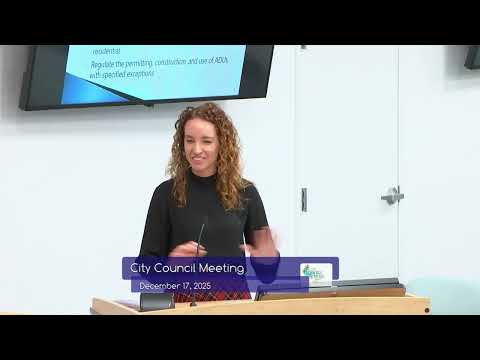
Jacqueline Gibson, community development staff, told the City Council that Florida bills moving through the Legislature (Senate Bill 48 and a companion House bill) would, if enacted, change “may” to “must” — requiring local governments to adopt ADU ordinances. Gibson said the bills in the packet would take effect on 07/01/2026 and that municipalities would be required to adopt an ordinance by 12/01/2026.
The presentation summarized the city’s existing ADU rules: downtown/form‑based code transects generally allow ADUs (the Imperial River/Imperial 41 transect excepted) with an 800‑square‑foot cap, shared utility connections and the units not counting toward density or additional impact fees. Outside downtown, accessory apartments are permitted in specified medium‑density and multifamily zoning districts (TSC 2, RM 2 and RM 6), while single‑family RS‑1 districts allow ADUs only by special exception. Gibson also listed size limits used by the city (attached units capped at 50% of the main dwelling; detached ADUs capped at 500 square feet or 50% of the main dwelling) and noted all ADUs require building permits and drainage plans.
Gibson warned the council about specific statutory preemptions included in the bill drafts: local ordinances could not require owner occupancy of the principal dwelling, could not regulate lease terms below 30 days, and could not require replacement parking when a garage or carport is converted. She also described other provisions in the drafts covering tenant screening reports, homestead exemption treatment and a state evaluation by the Office of Program Policy Analysis and Government Accountability on financing options and tiny homes.
Councilmembers and speakers from the public pressed staff on practical concerns. Councilmember Nigel said many property owners in the community view ADUs as an investment opportunity rather than an affordable‑housing tool and warned about potential changes to neighborhood character and increased enforcement workload. “I’m not against ADUs. No. I just wanna be the devil’s advocate here,” Nigel said during the discussion.
Councilmember Chris recommended treating the December 1, 2026, adoption date as a hard deadline and starting immediately. “What we need to do is start a calendar driven work plan that addresses legal, planning, permitting, and communications,” he said, urging staff to prepare a drafting strategy so the city could be compliant on day one if the bills are enacted.
Public commenters asked the council for more baseline data. Barb Ryan said she and her husband are in the process of constructing an ADU and asked, “How many ADUs do we already have? How many do you expect in the future?” She urged the council to separate construction/permitting standards from rental policy and to consider consistent environmental standards across districts.
Staff and council members discussed enforcement and tax collection for short‑term rentals, noting existing state preemptions on short‑term rental regulation and the city’s rental ordinance. Councilmembers expressed concern about locating unregistered short‑term listings and whether additional staff or better coordination with the local tax collector would be necessary to ensure compliance and collection of applicable taxes.
Gibson recommended further presentations and research and said staff would coordinate with legal counsel as needed. The council directed staff to continue developing options, pursue follow‑up presentations, and begin preparing a calendar‑driven ordinance work plan focused on legal review, permitting changes and communications ahead of the statutory deadline. No formal ordinance vote took place at the meeting.
The council received the briefing as information; staff will return with additional analysis, draft ordinance options and implementation details for council consideration.