Get Full Government Meeting Transcripts, Videos, & Alerts Forever!
Get email alerts on the Infrastructure Telecom topic
No spam. Unsubscribe anytime.
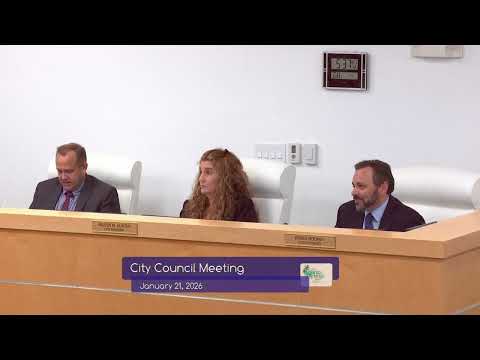
Bonita Springs explores options to improve cell coverage and prepares for mobility‑fee analysis
Summary
Council discussed persistent cell‑service gaps, potential steps — direct carrier outreach, consultant study, offering city parcels — and approved staff work on mobility/impact‑fee analysis and public workshops (citywide mobility plan on Feb. 12).
Bonita Springs council members spent significant time discussing long‑standing gaps in cell coverage and next steps to attract carriers, alongside staff planning for mobility‑fee or impact‑fee updates.
Council members raised safety and quality‑of‑life concerns tied to dead zones and 911 reliability. Staff and council debated practical approaches: hire a consultant to map optimal cell‑site locations, use the city’s lobbyist to convene carrier meetings, issue an RFP for tower siting on city or partner properties, or offer city‑owned land to incentivize carriers. Staff noted several permits are already in process, including Hunters Ridge, and estimated revenue from that site at roughly $65,000 annually.
Public comment urged deeper technical analysis: Ron George of Little Hickory Island recommended the Technology Advisory Board assemble carrier heat maps to locate actual coverage gaps and inform next steps. Elon (identified in the transcript by first name) and others explained carrier preferences — ground leases and 24‑hour access often favor standalone towers over rooftop installations — and warned that rooftop locations (for example, libraries or condos) can create operational and security complications.
Council members proposed several near‑term steps: (1) have staff and lobbyists arrange meetings with major carriers to learn short‑ and long‑term deployment plans; (2) consider targeted ground‑lease opportunities on city‑owned parcels or partner properties; and (3) evaluate whether an RFP or consultant study is needed to accelerate siting decisions. Some members favored meeting carriers directly to avoid delays that can accompany a consultant procurement; others argued that a consultant would give an independent technical site plan and identify multi‑carrier options to prevent exclusivity.
The council also discussed mobility and impact fees in light of pending state legislation. Staff said they will work with consultant Dr. Banyan and prepare scope and an RFP for an updated mobility/impact‑fee analysis; staff announced a citywide mobility plan public workshop on 02/12/2026 at 5:30 p.m. and a Paradise Road workshop on 02/26/2026 at 5:30 p.m. Staff framed mobility fees as broader than traditional road impact fees, noting mobility fees can fund sidewalks, bike lanes, bus stops and other multimodal improvements.
Next steps: staff will coordinate carrier outreach and return with recommendations (consultant scope, RFP, or direct meeting outcomes) and will advance the mobility‑fee analysis scope for council review and public workshops.