Get Full Government Meeting Transcripts, Videos, & Alerts Forever!
Get email alerts on the Conservation Funding topic
No spam. Unsubscribe anytime.
Conservation groups ask Garfield County to allow study of voter-funded wildfire, water and ranchland measures
Summary
Avalon Valley Land Trust and Middle Colorado Watershed Council asked the Garfield County commissioners at a Feb. 3 work session to permit nonbinding feasibility research and polling — not a tax or ballot placement — to assess whether voters would support a public funding mechanism for wildfire mitigation, source-water protection and keeping working ranchlands intact.
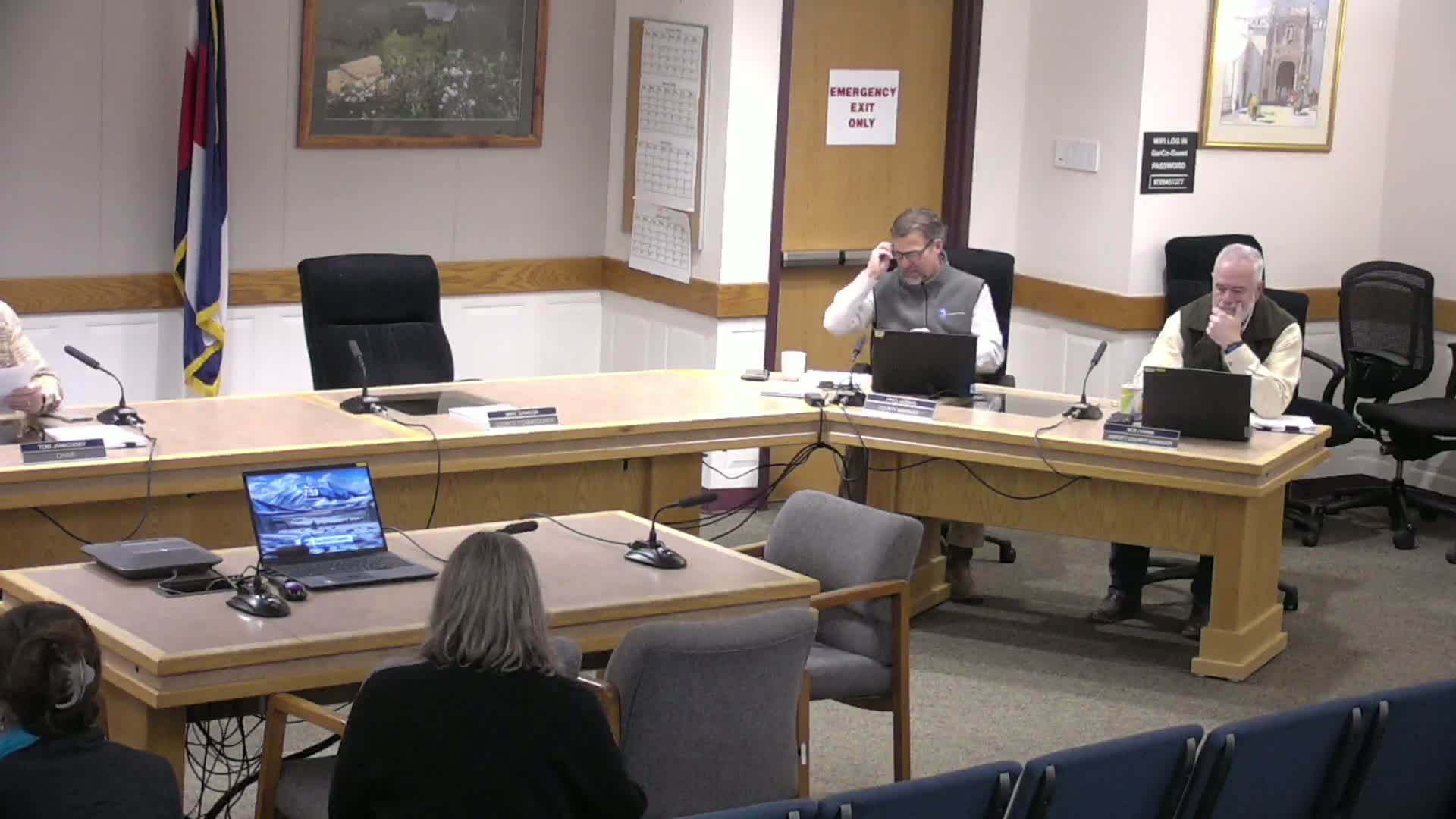
At a Garfield County Board of County Commissioners work session on Feb. 3, representatives from Aspen Valley Land Trust and the Middle Colorado Watershed Council outlined a proposal to study whether a voter-approved funding measure could support wildfire mitigation, water protection and working lands.
Kate Collins, executive director of the Middle Colorado Watershed Council, said the group had received a “pre-award notice on a $350,000 forest restoration and wildfire risk mitigation grant from Colorado State Forest Service,” and that the Trust for Public Land (TPL) would fund feasibility research while philanthropic money would pay for public-opinion polling. Collins said the research would explore revenue options, fiscal capacity, legal pathways and voter tolerance so that “any future decisions can be based on that data and the community voice, not on assumptions.”
Presenters stressed they were not asking the county to adopt a tax or place a measure on the ballot. TPL’s described role is technical assistance: designing an options analysis and, if warranted, arranging independent polling to test support and tax tolerance. Polling would evaluate voter support thresholds; presenters suggested a 62–63% favorable level as a practical bar for pursuing a ballot measure.
Commissioners voiced differing views. One commissioner said he was opposed to additional county taxes and would not vote to put such a measure on the ballot while in office, saying, “I am not for more taxes in this county.” Another commissioner said he supported letting voters decide. Staff noted a citizen initiative could proceed by petition independent of the Board, but presenters said they preferred to coordinate with county finance staff to get more accurate fiscal capacity analysis.
Public commenters representing local conservation districts told the commissioners that landowners are concerned that outside funding can become focused on administrative payroll and studies rather than delivering on-the-ground projects. Emily Schwaller, district manager of Book Cliffs Southside and Mount Sofar's Conservation Districts, said land stewards “feel like everything you guys have discussed is the full time position with the wildfire collaborative — no kind of outcome for that.” Presenters offered to meet with local stakeholders to explain how on-the-ground project funding could be structured.
No formal action was taken during the work session. Presenters asked for the Board’s blessing to proceed with research and stakeholder outreach; commissioners said staff would return with any action items if the Board wanted to consider formal involvement later. Commissioner Samuelson, not present at the meeting, was noted as the likely deciding vote if the Board were to take a final position.
The groups said next steps include negotiating scopes with TPL and an independent polling firm, continuing outreach to landowners, and returning to the Board with any action requests after feasibility work and initial polling.