Get Full Government Meeting Transcripts, Videos, & Alerts Forever!
Get email alerts on the Waste Management topic
No spam. Unsubscribe anytime.
Chaffee County weighs mattress recycling, cardboard drop-off and transfer-station options amid cost gap
Summary
County staff proposed short- and medium-term waste-diversion options — including a mattress-recycling pilot at roughly $43 per unit and a compacting cardboard drop-off — and warned federal funding delays and the government shutdown could delay a larger transfer-station project.
County staff laid out a menu of waste-diversion pilots and a budgetary gap tied to mattress recycling during Thursday’s meeting.
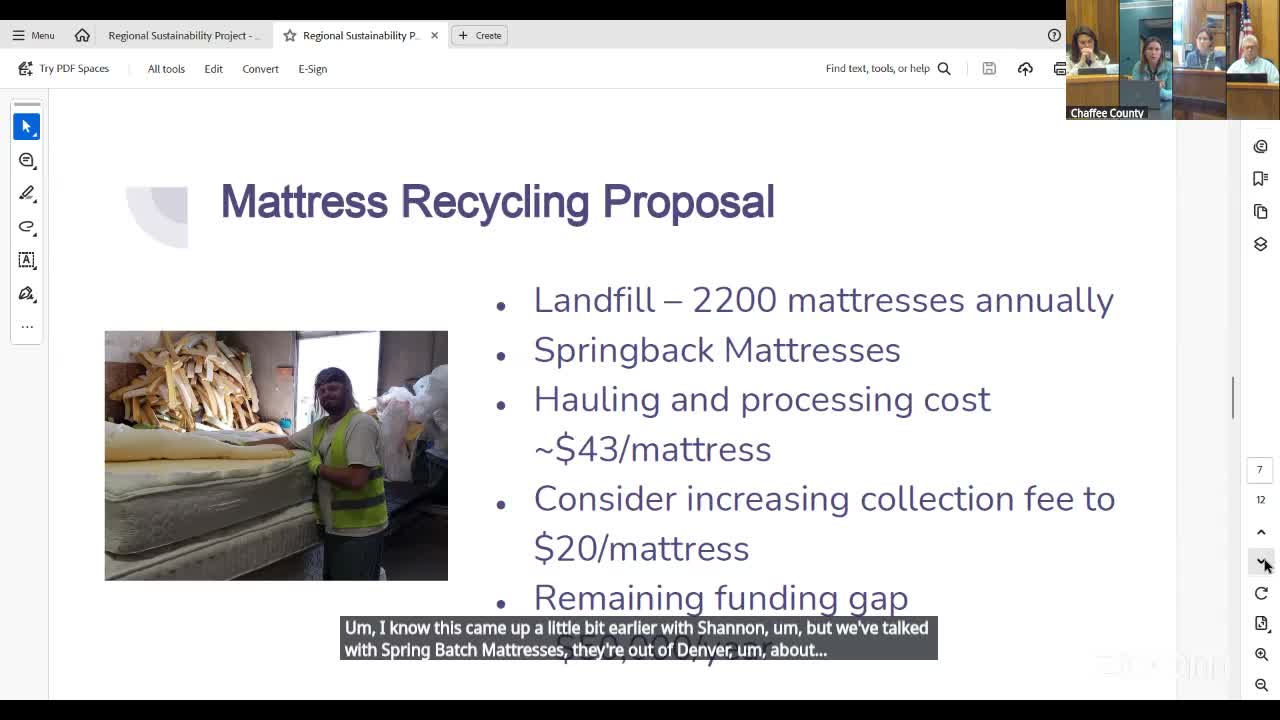
Beth and the county environmental/waste staff (Speaker 2) described discussions with Springbak, a Denver-based mattress recycler, under which recyclers would swap loaded trailers. Preliminary cost estimates for hauling and trailer expenses put recycling at about $43 per mattress, compared with the county’s current $10 landfill collection fee. Staff said the landfill receives roughly 2,200 mattresses a year; at current fees that would create an annual shortfall on the order of tens of thousands of dollars (staff estimated roughly $90,000 at $10 per unit). Increasing the customer fee to $20 per mattress would reduce the gap, staff said, to about $50,000 annually.
The board discussed potential commercial versus residential fee structures, participation by retailers offering mattress takeback services, and whether producers could help close the gap. Commissioners asked staff to break down how many incoming mattresses come from lodging or commercial operations versus individual households; staff agreed to analyze volumes by source.
On cardboard and short-term handling, staff proposed a compacting roll-off at the landfill that would reduce hauling costs and increase transport efficiency. A county-owned compactor is a roughly $40,000 upfront investment (plus pad and electrical work), with monthly hauling costs that would scale by frequency; staff noted grant programs and EPR (Extended Producer Responsibility) reimbursements could offset equipment and operational costs.
Staff also updated the board on a longer-term transfer-station buildout (the county has used placeholder names like “Merf/Swiffer”) that would create a regional diversion hub; federal funding uncertainty tied to the recent shutdown has delayed contract execution and could threaten the project’s timing and access to implementation funds.
Next steps: staff will return with a mattress-source breakdown, options for fee structures (residential vs. commercial), and a detailed cost-benefit analysis for the mattress and cardboard proposals, including labor and utility operating estimates requested by commissioners.