Get Full Government Meeting Transcripts, Videos, & Alerts Forever!
Get email alerts on the Commercial Solar Policy topic
No spam. Unsubscribe anytime.
Planning commission debates commercial solar moratorium, weighing farmland protection against energy development
Summary
Commissioners and residents discussed a county moratorium on commercial solar and whether to amend the comprehensive land use plan; public commenters urged protecting prime farmland and township officials reported opposition to large solar arrays in scenic agricultural areas.
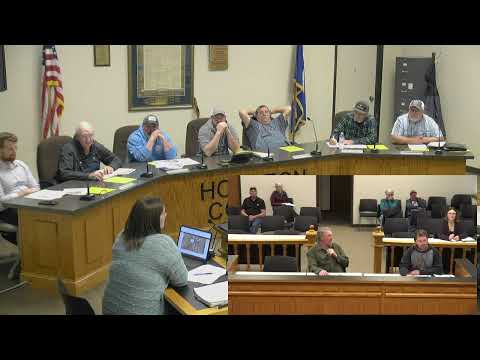
The Houston County Planning Commission spent a substantial portion of its meeting reviewing a moratorium the county placed on commercial solar development and discussing whether to amend the county’s comprehensive land use plan or adopt specific performance standards.
Staff told the commission the moratorium, adopted by the county commissioners in December, was intended to give officials time to research what local rules can and should allow. Staff presented a conservative interpretation of the current comprehensive land use plan, saying it prioritizes protection of prime farmland and would likely allow only smaller distribution-level systems — not large transmission-level projects that are regulated by the state.
Commissioners and members of the public debated how to balance farmland protection with the economics of commercial solar. Several residents argued for protecting prime tillable land and restricting commercial arrays to marginal or nonprime farmland. One township representative said his township association’s consensus was opposition to large solar projects in their scenic, agricultural area.
Technical questions at the meeting covered size thresholds and infrastructure: staff referenced a planning rule-of-thumb of roughly 4 to 5 acres per megawatt and noted limited existing transmission capacity in parts of the county. Speakers also discussed the risk that, for very large projects, state-level review and incentives could limit the county’s authority.
Staff said they will draft proposed performance standards and a distribution-level alternative and present a draft to the planning commission in May for a public hearing and comment. Any recommendation from the planning commission would then go to the Board of County Commissioners for a final decision.
Public commenters urged transparency and argued for clearer rules before commercial-scale projects are permitted. Commissioners signaled they want to protect the county’s agricultural base and that any new standards should at minimum be no less restrictive than current rules governing dwelling density on prime farmland.
The matter remains a policy discussion at the planning-commission level; no regulatory changes were adopted at the meeting and the commission asked staff to prepare draft language for the next meeting.