Get Full Government Meeting Transcripts, Videos, & Alerts Forever!
Get email alerts on the Energy And Infrastructure topic
No spam. Unsubscribe anytime.
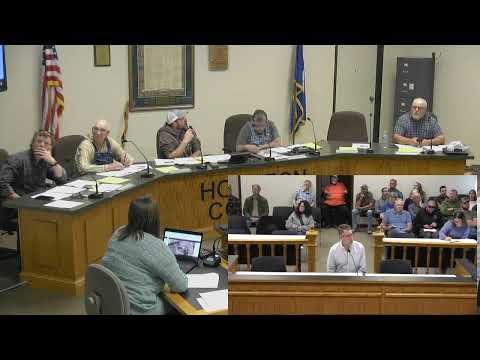
Planning commission hears hours of public comment on draft solar ordinance and backs six‑month moratorium extension
Summary
After hours of divided public comment about commercial solar on prime farmland, the Houston County Planning Commission recommended a six‑month extension of its interim moratorium to allow staff and commissioners to refine a draft commercial solar ordinance and comprehensive‑plan amendment.
The Houston County Planning Commission held an extended public hearing on a preliminary draft commercial solar ordinance and proposed comprehensive plan amendments, heard dozens of public comments both for and against allowing large solar arrays on prime farmland, and voted to recommend a six‑month extension of the county’s interim moratorium on commercial solar to give staff time to refine the draft.
Staff presented a draft modeled in part on Winona County language that would keep small accessory solar as a permitted use while creating a new permitting pathway for larger commercial solar fields (primary land use). The draft proposes treating large commercial arrays as an interim use with a defined project lifespan, decommissioning requirements, setbacks from dwellings (staff proposed 500 feet), scenic‑byway buffers, screening, bonding for decommissioning, and options to require dual use (eg, pollinator seed mixes or sheep grazing) to preserve agricultural function.
Public comment was divided. Several local farmers and landowners urged the commission to protect prime agricultural land. "I don't really have any gripes about solar panels whatsoever, but what I do have gripes about is occupying prime ag land for solar panels," landowner Clint Vonirks said. Farmers emphasized the county land‑use plan and the long‑term scarcity of high‑quality farmland.
Developers and the utility argued for a balanced approach that allows projects near substations and under strict conditions. Beth Esher of 1 Energy Renewables described industry practices including agrivoltaics, pollinator seed mixes and sheep grazing, and said companies commonly include decommissioning and soil‑restoration commitments in leases. Kent Whitcomb, vice president of member services at MiEnergy Cooperative, said utility‑scale projects can help stabilize wholesale costs and generate local township and county revenue; he urged allowing projects on some prime acres if dual‑use conditions preserve agricultural function. "Our mission statement is to safely provide reliable, affordable, and sustainable services," Whitcomb said.
Other commenters expressed technical concerns about stormwater, runoff, karst and installation impacts, the visual effect of arrays near dwellings, and the adequacy of proposed setbacks and separation distances. National‑interest groups and local advocates also questioned whether strict restrictions could unduly limit private property rights or prevent utilities from meeting future renewable portfolio obligations.
After discussion, commissioners concluded more study was needed to balance farmland protection, siting near existing distribution infrastructure, decommissioning assurances, and possible conditioning on dual use. The commission voted to recommend a six‑month extension of the interim moratorium to the County Board so staff can prepare refined ordinance language and more detailed screening criteria. That extension recommendation will be transmitted to the Board for consideration in June.