Get Full Government Meeting Transcripts, Videos, & Alerts Forever!
Get email alerts on the Governance topic
No spam. Unsubscribe anytime.
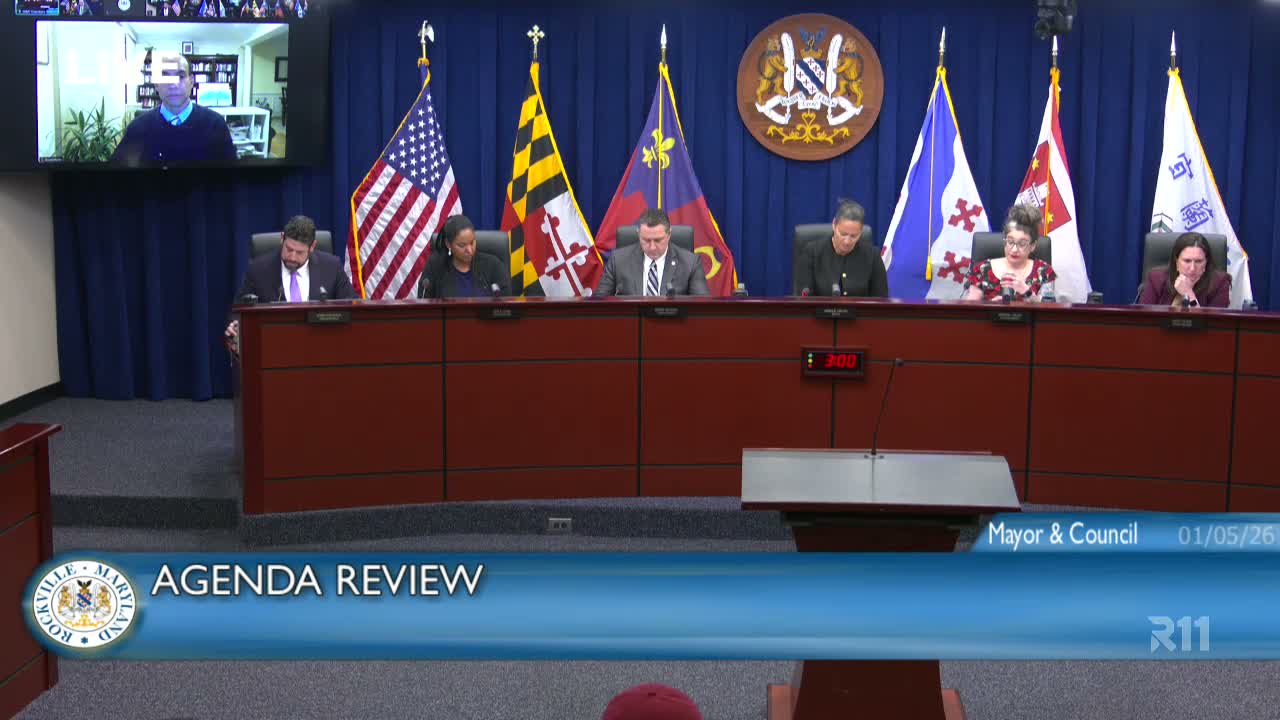
Rockville council debates tighter meeting rules, asks staff to return consolidated resolution in three months
Summary
Council reviewed a proposed ordinance to tighten meeting rules — including rotating speaking order, question limits and thresholds for adding items to future agendas — and directed staff to return a consolidated resolution and related guidance after a three-month trial and revisions.
Rockville Mayor and Council spent the bulk of their Jan. 5 meeting debating a staff-drafted ordinance that would revise the council—meeting rules and procedures, then asked staff to return a consolidated resolution and companion guidance within about three months.
City Manager Jeff Mahalick presented the draft as an effort to increase clarity and efficiency by codifying agenda definitions, aligning procedures with Robert——————Rules of Order, and encouraging meetings to conclude by 10 p.m. The draft would raise thresholds for removing agenda items during meeting review (six members) and for placing items on a future agenda (four members), require clearer definitions of agenda types, set a target to complete meetings by 10 p.m., and propose a rotating order of recognition and limits on questions during the staff-question phase.
Council members expressed mixed views. Several said they wanted less prescriptiveness and more flexibility so deliberation and debate are not stifled; others supported guardrails to promote equity and predictable public engagement. On thresholds, multiple council members preferred lowering the proposed four-member threshold for placing items on future agendas to three. Several members said separating a question period from a deliberation period could improve clarity but worried it might make conversations less organic and potentially lengthen meetings. Accessibility and accommodation concerns (for example, for neurodivergent members and members with different communication styles) were raised in connection with rigid time or turn-taking rules.
City Manager Mahalick and City Attorney Robert Dawson said staff could produce a compact, plain-language resolution and two stand-alone documents: one with public-hearing guidance and another a procedural "cheat sheet" on motions. The council directed staff to return a combined rules-and-procedures document as a resolution, try a rotating-order practice in meetings before codifying it, and bring the draft back for council review in roughly three months. There was no formal ordinance vote on Jan. 5.
The next steps are procedural: staff will prepare the consolidated resolution and related guidance, circulate drafts to the council and clerks, and present the package for formal consideration after the trial period. The manager said staff will incorporate clearer definitions, address how abstentions affect majority and supermajority counts, and add transparency elements (such as delivering staff reports seven days before meetings where practicable).