Get Full Government Meeting Transcripts, Videos, & Alerts Forever!
Get email alerts on the Signage Ordinance topic
No spam. Unsubscribe anytime.
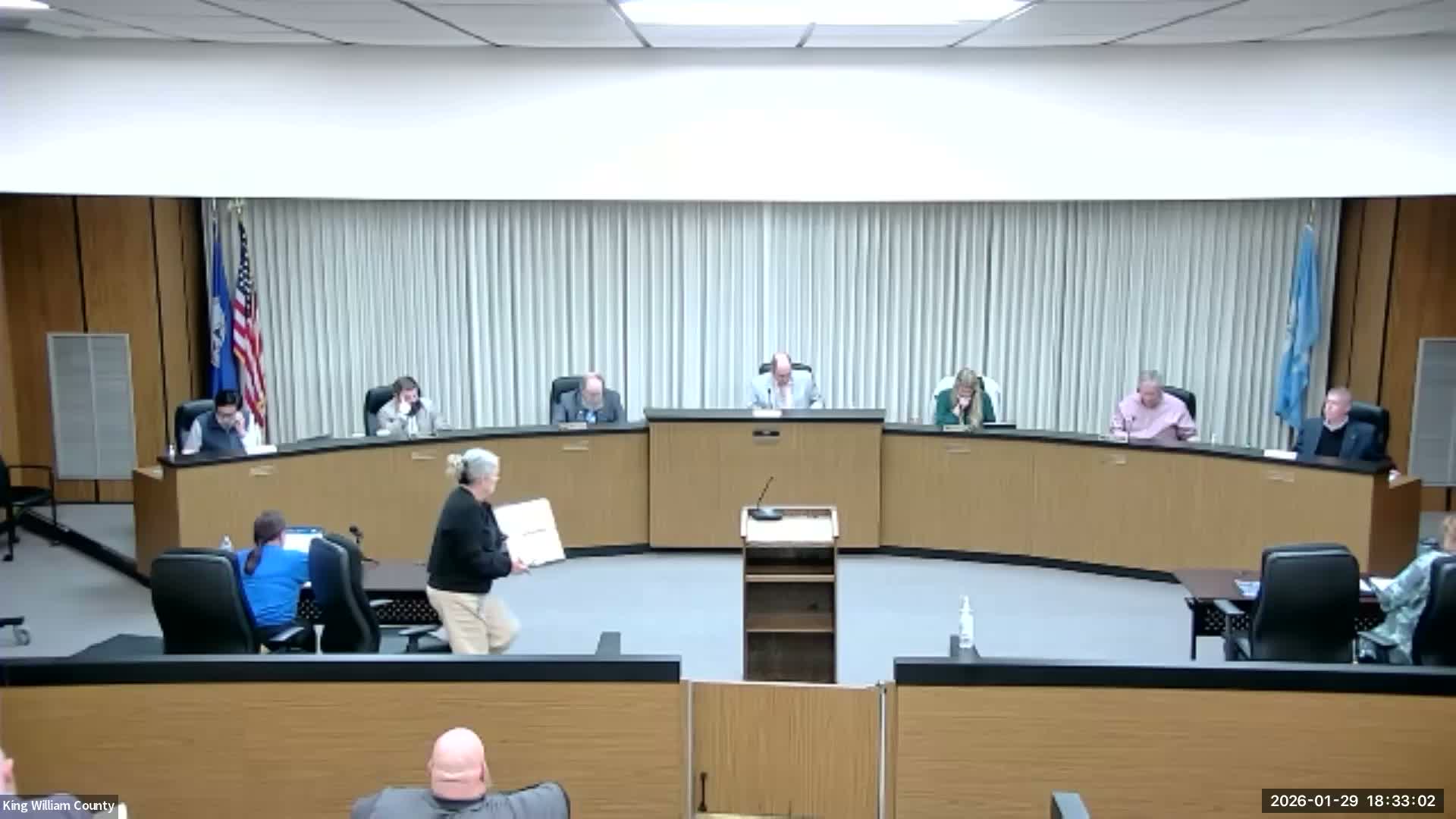
King William Board adopts updated sign ordinance to clarify definitions, limit illumination
Summary
The Board of Supervisors adopted amendments to Article 10 (signage) that add definitions, include industrial-district rules, and reduce allowable illumination levels for digital and internally lit signs; the change formalizes prior workshop consensus and includes visual measurement guidance for applicants.
Joyce Wolf presented proposed amendments to Article 10 of King William County’s zoning code to clarify sign types, add signage rules for industrially zoned parcels, and revise illumination limits for digital and internally illuminated signs. Wolf said the prior ordinance contained unclear or contradictory language — including a current illumination limit written as “no greater than 10,000 foot candles,” which she described as equivalent to full unobstructed sunlight — and recommended revising that standard. She also said the updates add measurement illustrations and definitions so applicants and staff have consistent guidance.
Board members asked about the number of existing nonconforming signs and potential costs to businesses; Wolf said she did not have a precise count but noted the county’s 2021 ordinance already limited many business signs to 15 feet in height and that most adjustments involve clarifying, not immediately replacing, existing signage. Following a brief public-comment window (no substantive opposition recorded), a supervisor moved to approve the ordinance update. The board approved the measure by roll-call vote.
The ordinance update stems from a February 2025 introduction, an EDA review in March, and a joint workshop last December between board and planning commission leadership. The changes the board adopted were presented as unchanged from the April version that had been tabled previously, apart from an EDA-recommended revision noted by staff.
The board recorded the roll-call approval during the meeting. The ordinance will take effect consistent with the county’s code-adoption process and will be available through county planning staff for applicants and businesses seeking to confirm compliance.
The board directed staff to finalize revised code language for public availability and to assist applicants with measurement and digital-sign brightness requirements as the county transitions to the updated rules.