Get Full Government Meeting Transcripts, Videos, & Alerts Forever!
Get email alerts on the Budget topic
No spam. Unsubscribe anytime.
King William supervisors debate 3.5¢ tax-rate increase as staff lays out three budget scenarios
Summary
At a May 12 meeting, county staff presented three FY2026 budget scenarios tied to a proposed 3.5¢ per $100 tax-rate increase that staff projects would raise about $2.6 million; supervisors questioned revenue assumptions, flagged accounting concerns and deferred final budget action to upcoming meetings.
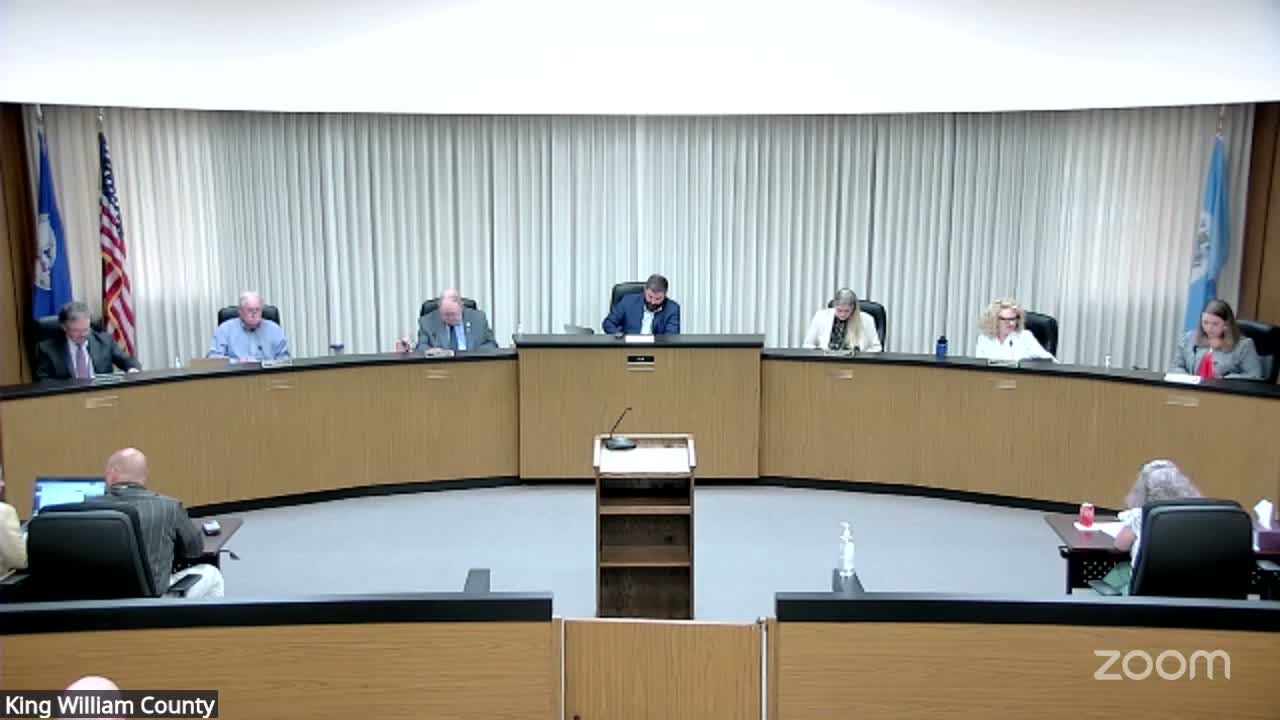
County staff and supervisors at the King William County Board of Supervisors meeting on May 12 continued a contentious discussion of the proposed FY2026 tax rate and budget choices, focusing on a proposed 3.5¢ per $100 increase and its projected revenue.
At the public hearing staff clarified advertising errors and explained that public-service personal property had been separated into vehicle/truck and non-vehicle categories; the advertised county real-estate rate increase of 3.5¢ would affect county (not school) funds, staff said (Speaker 7). "For tonight's hearing, specifically ... we did break one apart," Speaker 7 told the board when enumerating the corrected categories.
Budget staff (Ms. Stevens, first identified in the transcript as preparing scenarios) presented three scenarios. "Scenario number 1 is with the tax increase that we proposed," Ms. Stevens said, describing a plan that would fund a 3% cost-of-living adjustment, convert a part-time treasurer position to full time, add animal control and sheriff's positions, and add seven firefighter positions for Station 1. According to staff materials, Scenario 1 reduces the county's draw from unassigned reserves relative to a flat-funded alternative.
Staff said the 3.5¢ increase would generate roughly $2.6 million in general property tax revenue for FY2026. Board members repeatedly questioned that projection because it includes an assumption of approximately 300 additional certificates of occupancy (COs) tied to new housing development. "We can't bank on that additional revenue," one supervisor said after other members described infrastructure and construction timelines as unlikely to produce 300 COs in a single year.
Several supervisors pushed back on whether the revenue assumptions and other accounting items are reliable. One supervisor urged an in-depth financial review, saying the county needs "a fresh set of eyes to look at the county finances, do a 100% audit of our books, and get these issues sorted out and fixed." Board members also noted outstanding discrepancies in the Comprehensive Annual Financial Report (CAFR) and discussed an open RFP for auditing services.
Members debated alternatives to the tax increase, including cutting staff or deferring new positions; staff warned that removing the tax increase without additional cuts would add roughly $935,000 to the budget gap. Several supervisors emphasized services that could be affected, including deputies and fire/EMS staffing, and said the long-term consequences of tapping reserves could be more severe.
No formal action on the tax rate was taken at the hearing; board members agreed to continue the budget conversation during the unfinished-business portion of their agenda and to address budget adoption at upcoming meetings. The board set a follow-up (the next meeting was scheduled for May 19) and was reminded that state timelines require adopting educational budgets within state-prescribed windows (staff counsel read relevant statutory timelines during the discussion).