Get Full Government Meeting Transcripts, Videos, & Alerts Forever!
Get email alerts on the County Budget topic
No spam. Unsubscribe anytime.
King William supervisors debate 3.5¢ tax increase as schools and public safety seek funds
Summary
At a May 5 special meeting, the King William County Board of Supervisors discussed a proposed 3.5¢ real-estate tax-rate increase to close an FY26 gap, debated staffing and equipment requests for fire/EMS and the sheriff, and examined school reserve constraints; staff were asked to model alternative scenarios ahead of adoption deadlines.
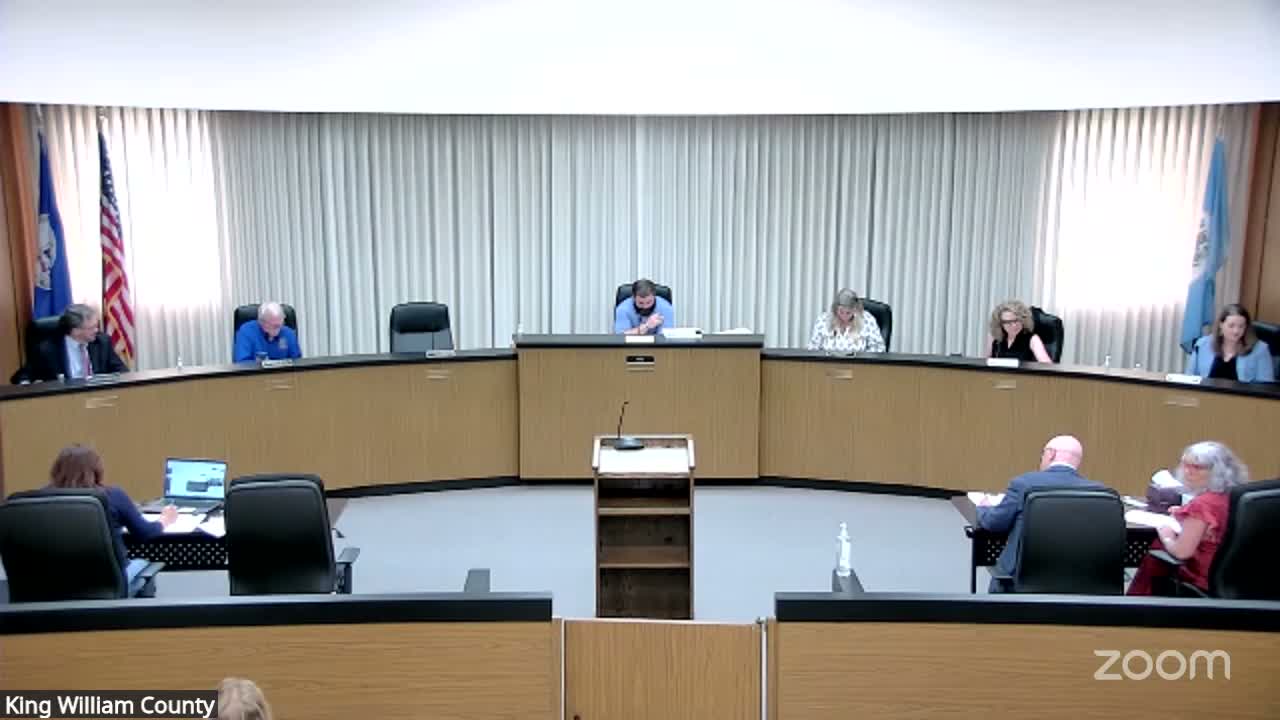
King William County’s Board of Supervisors spent a May 5 special meeting weighing whether to raise the real-estate tax rate by 3.5¢ to help cover rising costs for schools, public safety and county operations. The board did not adopt the budget but directed staff to run additional scenarios and scheduled further action consistent with state deadlines.
The board opened with a review of the packet and a single-item agenda focused on the proposed FY26 budget. Fire and EMS representatives asked the board to fund a staffing increase that would expand advanced life-support coverage to four-person, 24/7 crews. A fire chief told the board the department was requesting funding to double staffing and that payments could be structured so the county only pays when the staffing actually exists: “We could absolutely bill that according to when we do have extra staffing,” the chief said.
The sheriff described current vacancies and said he was not seeking the full set of additional deputies previously discussed; his immediate requests were focused on an animal-control officer, a court/transport position, a records specialist and IT support for public safety systems.
Several supervisors expressed reluctance to impose the proposed tax increase on residents. “I’m still not a fan of the 3 and a half cent per 100 real estate increase,” one member said, urging staff to identify offsets or use reserves instead of increasing taxpayers’ bills. Other members pushed back that not addressing structural shortfalls could produce larger increases in future years and leave the county repeatedly drawing down reserves. Staff and the chair discussed options including delaying some hires, funding positions only when filled, and asking the school division to reduce its county request by drawing on reserves.
Board members and finance staff walked through how split-levy and restricted school funds are accounted for, and several members were cautioned that much of the county’s reported balances are restricted and therefore not freely available for reallocation. The board heard that the school division originally requested about $1.1 million and that the current proposal had been cut to $750,000; members debated whether the schools could use reserves to reduce the county ask.
Staff confirmed some scenario modeling had been run—removing all new positions would reduce the structural gap—but the board asked for targeted scenarios that would combine a tax-rate change with selective position cuts (for example, not adding a particular set of deputies) so members could see the trade-offs. Counsel and staff also reviewed deadlines: the school budget is expected to be adopted by May 15 and the board may act on tax rates after the public hearing that has already been advertised.
The board also flagged program priorities to guide the next round of work: schools, fire and EMS coverage and employee recruitment/retention. Supervisors emphasized the need to balance fiscal responsibility and community impacts while noting recruitment and retention challenges for public-safety roles. The meeting ended with direction to staff to prepare options and additional financial detail ahead of the next decision points.
No final budget adoption or final vote on the tax rate was recorded at the meeting. The board scheduled further deliberations and scenario analysis before any formal adoption.