Get Full Government Meeting Transcripts, Videos, & Alerts Forever!
Get email alerts on the Meeting Outcome topic
No spam. Unsubscribe anytime.
Zoning Commission approves bulk of consent agenda and forwards multiple rezones to City Council
Summary
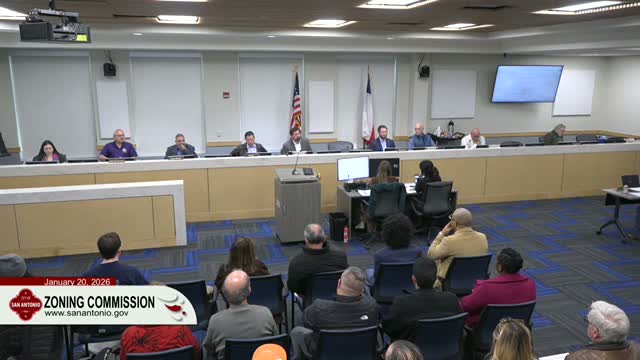
The San Antonio Zoning Commission approved a large consent agenda and several individual rezoning requests during its Jan. 20 meeting, forwarding the items to City Council for final action. The meeting included continuances, contested hearings, and several split votes on discretionary items.
The City of San Antonio Zoning Commission on Jan. 20 approved a large consent package of rezoning requests and forwarded several contested items to City Council.
The commission read a combined hearing list that included items 4, 5, 7, 11, 12, 13, 14, 15, 19, 20 (as amended), 23, 25, 28 and 29. After a brief public comment period and no requests to pull most items, Commissioner Ken Huey moved to approve the listed items as amended; the motion was seconded and carried on a roll-call vote. Chair John Bustamante said applicants now have six months to present their cases to City Council.
Beyond the consent list the commission considered more than a dozen individual items including continuance requests (several cases moved to February hearings), multiple conditional-use petitions to formalize accessory dwelling units, and site-specific conditional districts. Notable outcomes sent to council include the approval of Item 1 (607 South Kamal Street) to IDZ3 for lumber-yard compatible uses, Item 2 and Item 3 related to properties on Easterling Road (forwarded after debate), Item 4 (East Savallos) recommended for IDZ1 to support a neighborhood-serving restaurant, and Item 26 (South San Marcos) approved to allow a site-specific infill use.
The commission also approved minutes from its Dec. 16, 2025 meeting by acclamation and adjourned at 5:23 p.m.
What happens next: Each applicant whose request was recommended will have their case scheduled before City Council, where elected members take final action. Applicants and affected residents may use the council process to offer additional testimony or conditions.