Get Full Government Meeting Transcripts, Videos, & Alerts Forever!
Get email alerts on the Land Use Municipal Utility District topic
No spam. Unsubscribe anytime.
San Antonio planning commission recommends denial of consent for Guadalupe Ranch MUD after hours of public opposition
Summary
After a daylong hearing with more than 60 speakers and technical exchanges about hydrology, traffic and emergency access, the Planning Commission voted to recommend that City Council deny city consent for formation of a municipal utility district to serve the proposed Guadalupe Ranch subdivision.
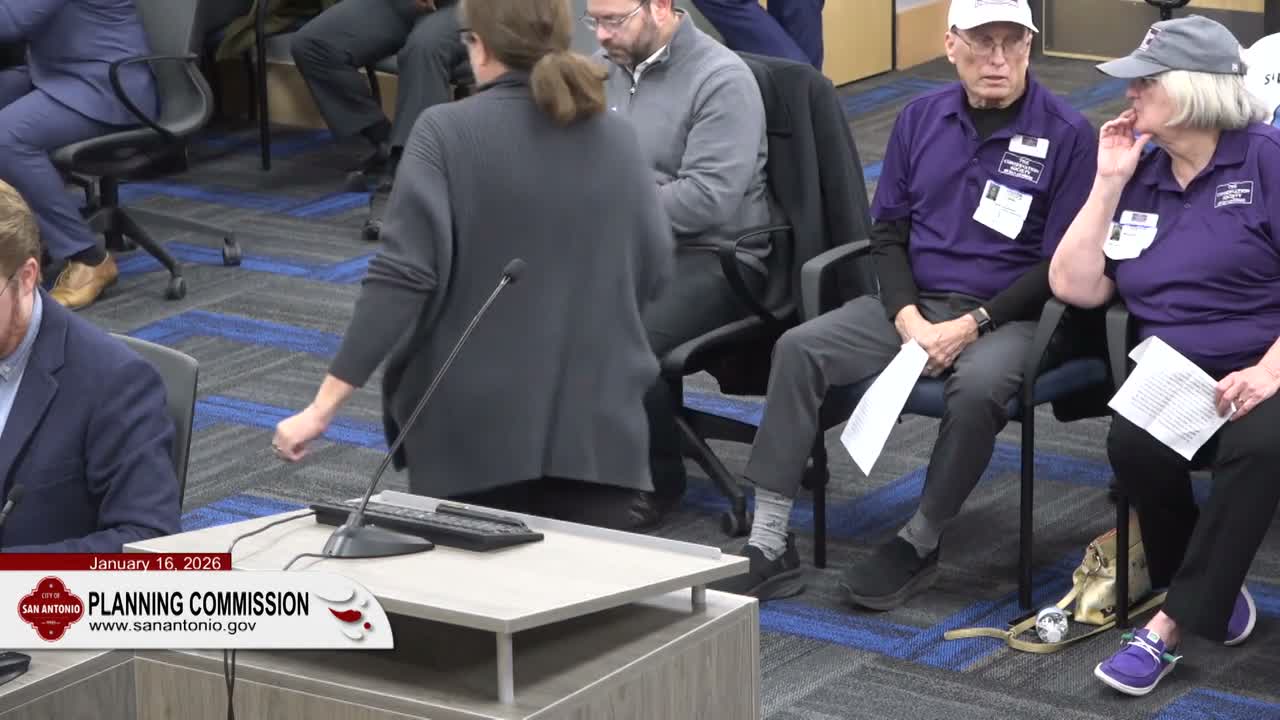
The City of San Antonio Planning Commission on Jan. 16 voted to recommend that City Council deny the city's consent to creation of a municipal utility district (MUD) for the proposed Guadalupe Ranch subdivision, a roughly 1,160-acre master-planned community that the developer says would include about 3,000 single-family homes served by an on-site wastewater treatment plant.
Commissioners heard a three-hour staff and applicant presentation and more than four hours of public comment, much of it from residents, neighborhood associations and environmental groups who warned the proposed MUD and its wastewater treatment plant could put the Edwards and Trinity‑Glen‑Rose aquifers at risk. Priscilla Rosales Piña, planning manager for the city, told the commission the item before the body was whether to recommend that the city give its consent — a statutory step that can shape a later development agreement and the city's role in imposing conditions.
Kevin Deanda, the applicant's representative, said Lennar Homes and its partners have secured three major entitlements for the site, including a TCEQ discharge permit (granted after a multi-year contested review), a SAWS utility service agreement and an approved master development plan. Deanda said the MUD would allow the developer to be reimbursed for public improvements that the company would construct up front, that the wastewater plant would be operated under a Class A operator contract, and that settlement terms and the utility service agreement include conditions intended to limit impacts, such as a cap on impervious cover and commitments to beneficial reuse of treated effluent on open space.
Hundreds of residents and organized groups urged denial. Louis Vetter of the Conservation Society of San Antonio said the proposed plant sits over an area tied to regional recharge and that even treated effluent can carry contaminants and pharmaceuticals. Multiple speakers cited a Southwest Research Institute report and TCEQ compliance records for some nearby plants, and many warned that single access points, limited notice to emergency responders and the prospect of bonds and ad valorem taxes assigned to future homeowners raised public‑safety and fiscal concerns.
Commission discussion focused on a narrow legal point and a broader policy trade-off: the commission's recommendation would not itself create a MUD but would determine whether the city participates in an accompanying development agreement that can require additional protections (for example, future voluntary annexation and enforcement rights). Staff explained that if the city denies consent the developer could still petition TCEQ for district creation; if the city consents, the development agreement gives the city greater leverage over terms such as operator standards and infrastructure commitments.
Councilman Munguia moved to recommend denial of the city's consent; the motion was seconded and, after a roll‑call vote, the commission announced the motion passed. The recommendation will now be transmitted to City Council, which is scheduled to consider the consent on Feb. 5.
The commission's public record for the hearing includes the applicant's presentation describing a membrane bioreactor (MBR) tertiary treatment system, SAWS's utility service agreement restrictions, and the developer's estimate of roughly $150 million in public improvements. Opponents cited figures in the hearing record and public comments describing an average discharge cited by speakers of about 1,000,000 gallons per day; the applicant and its technical witnesses said the project's discharge permit and contested‑case record addressed effluent limits, site geology (including a confining layer described in expert testimony) and plans for beneficial reuse of effluent on-site, with outfalls only when reuse is not technically feasible.
What happens next: Planning Commission's recommendation will be part of the record before City Council when it considers whether to consent to the MUD and to approve any related development agreement. If City Council denies consent, the developer retains the option to pursue creation of a MUD through TCEQ's process; if the city consents, the development agreement terms would take effect and provide the city additional enforcement tools and negotiated conditions.
Reporting note: Article quotes and attributions are drawn from the Planning Commission's hearing transcript and on‑record presentations. The commission meeting was a recommendation vote; the City Council (not the commission) has final authority to consent under the statutory process.