Get Full Government Meeting Transcripts, Videos, & Alerts Forever!
Get email alerts on the Chapter 18 Rewrite topic
No spam. Unsubscribe anytime.
Rockville staff outline major landlord‑tenant code changes: 2‑year leases, algorithmic ban, fee transparency and repair‑and‑deduct
Summary
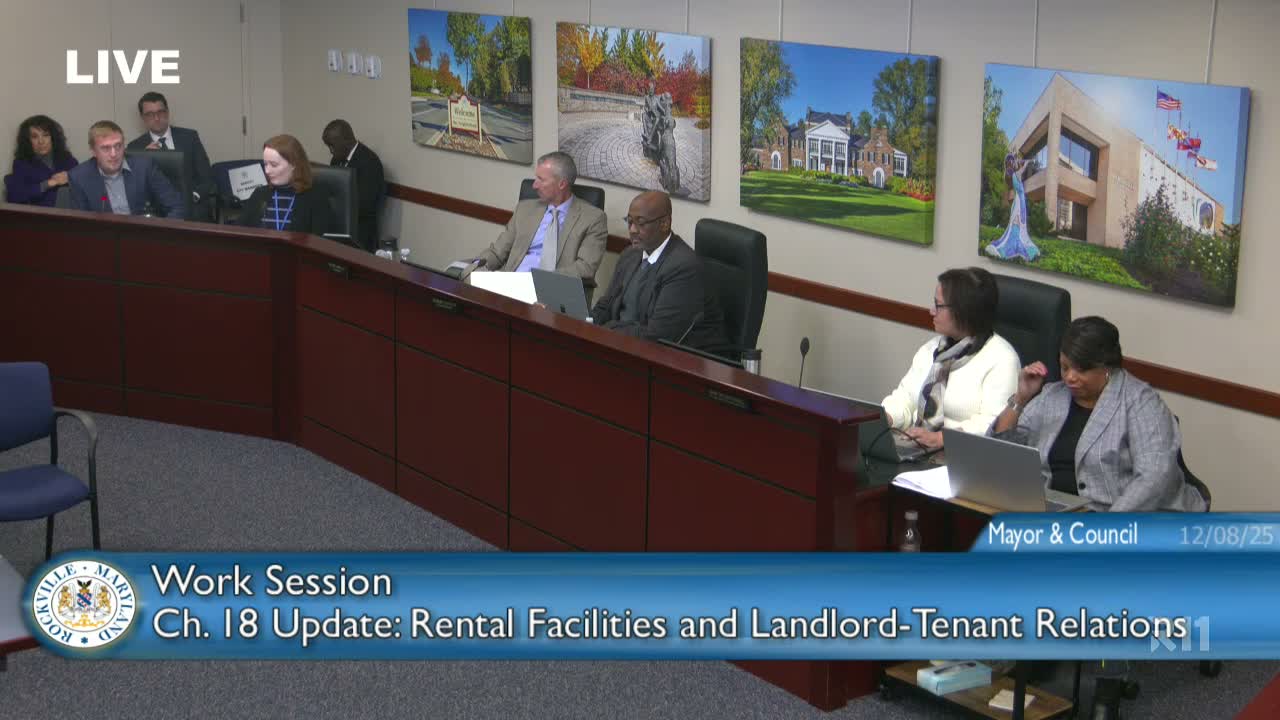
City staff presented a draft of proposed revisions to Chapter 18 Dec. 8, including requiring landlords to offer two‑year leases, banning algorithmic rent‑setting that uses non‑public competitor data, tightened fee disclosure and limits, new repair‑and‑deduct rules, and data‑reporting changes. Council asked for more data on fee caps and safeguards for small landlords; staff will draft code language for spring return.
Rockville staff presented a broad rewrite of Chapter 18 of the city code — the chapter that governs rental housing and landlord‑tenant relations — laying out both clarifying alterations and new policy proposals aimed at increasing housing stability and fee transparency.
Jane Lyons Raider, housing programs manager in the Department of Housing and Community Development (DHCD), and Trevor Stevens, the city's landlord‑tenant specialist, summarized public engagement and new policy proposals. Staff said suggested alterations include clearer definitions, adding ‘improve housing stability’ to the chapter’s purpose, requiring landlords to offer two‑year lease terms, expanding early‑termination reasons (for example domestic violence or a unit declared uninhabitable), shortening the time to provide an executed lease copy to three business days, affirming tenants’ right to organize, and ensuring tenants may obtain a full rental‑payment history.
On new policies, staff recommended a ban on algorithmic rent‑setting that uses non‑public competitor data, model restrictions on court costs and attorney fees in leases, detailed fee‑disclosure requirements in advertising and lease documents, and civil remedies for fee violations (including potential treble damages plus attorney fees). Trevor Stevens also described a repair‑and‑deduct framework modeled on Montgomery County, proposing a higher maximum deduction (staff discussed raising the county’s one‑month cap toward a potential two‑month maximum) and requiring tenants to use licensed contractors and follow notice/inspection steps.
Councilmembers broadly praised staff’s direction but pressed for additional data and refinements. Several members urged a plain‑language lease summary, stronger upfront disclosure of fees (including itemized utility and trash estimates), and careful drafting to prevent small landlords from being unduly burdened. Council members also asked staff to compare fee restrictions to other jurisdictions and analyze whether a two‑year lease requirement could prompt landlords to increase upfront rent or produce other unintended market effects. Multiple councilmembers expressed support for requiring landlords to notify the city when they issue an eviction notice (moving from a six‑day to 14‑day tenant notice was discussed) so the city can better target outreach and assistance.
Staff said they will draft the actual code language and return in a later work session (spring) with more detail, analysis on fee impacts, and follow‑up research on relocation assistance and other programmatic tools.
Next steps: staff to produce draft ordinance language for council review in the spring, and to provide comparative fee data and impact analysis requested by council.