Get Full Government Meeting Transcripts, Videos, & Alerts Forever!
Get email alerts on the Healthcare Services topic
No spam. Unsubscribe anytime.
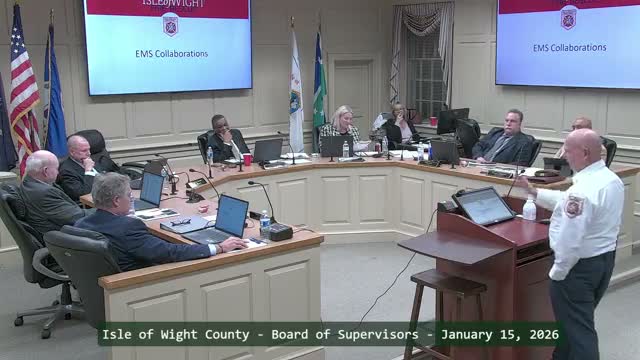
Fire‑rescue chief outlines community paramedicine plan to reduce frequent 911 calls
Summary
Fire‑rescue Chief Gary Windling told supervisors EMS calls have risen ~9% year-over-year and that 45% of calls do not result in hospital transport; he proposed a community paramedicine/mobile integrated health program, staffing and vehicle needs, and potential billing/grant offsets.
Gary Windling, chief of Isle of Wight County Fire‑Rescue, presented a proposal to shift EMS from reactive responses toward proactive community paramedicine (mobile integrated health) to lower demand on 9‑1‑1 and improve patient outcomes. Windling said the system has seen a 9% increase in total calls between 2024 and 2025 and a 15% increase since 2021, and that 45% of EMS calls in the county do not result in patient transport to the hospital.
Windling told the board that a small share of addresses generate a disproportionate number of calls: six addresses in 2025 required more than 20 responses each and 3+ calls to frequent callers accounted for 2,197 calls. He described community paramedicine work that could include home visits for medication review, fall-prevention interventions (handrails, rugs, ramps), checking oxygen concentrators, coordinating post-discharge follow-up with hospitals, and linking residents without primary care to casework and services.
On staffing and cost, Windling said the program would require a supervisor-level coordinator (a lieutenant‑level position in the department), part‑time certified MIH personnel to perform visits (he said some part-time staff already hold MIH certification), and a vehicle for field visits. He told supervisors that Medicare billing is possible for certain MIH services, and that Suffolk and York County operate similar programs.
Board members asked about return on investment and reimbursement assumptions; one supervisor asked whether staff could model a profit-and-loss projection so the board could see offsetting revenues and how a requested $230,000 (an example figure discussed as a possible budget addition) would fit into FY 26–27 planning. Windling said staff could prepare those estimates if funding and positions were approved.
Windling also noted clinical oversight would come from a medical director: the county’s new medical director, Dr. Clifford (Riverside System), would sign off on MIH protocols and allowable clinical activities.
No formal funding decision was made at the meeting; supervisors asked staff to develop cost projections, reimbursement estimates and program details for upcoming budget discussions.