Get Full Government Meeting Transcripts, Videos, & Alerts Forever!
Get email alerts on the Code Enforcement topic
No spam. Unsubscribe anytime.
San Antonio outlines new Code Enforcement Strategic Plan with focus on transparency, vacancies and simplified tiers
Summary
City staff presented a draft Code Enforcement Strategic Plan shaped by consultant listening sessions and a 2023 CCR; proposed actions include centralizing case data, improving BuildSA customer updates, expanding vacant‑lot abatement capacity and consolidating enforcement into two tiers. Council pressed for clearer timelines and better 3‑1‑1 communication.
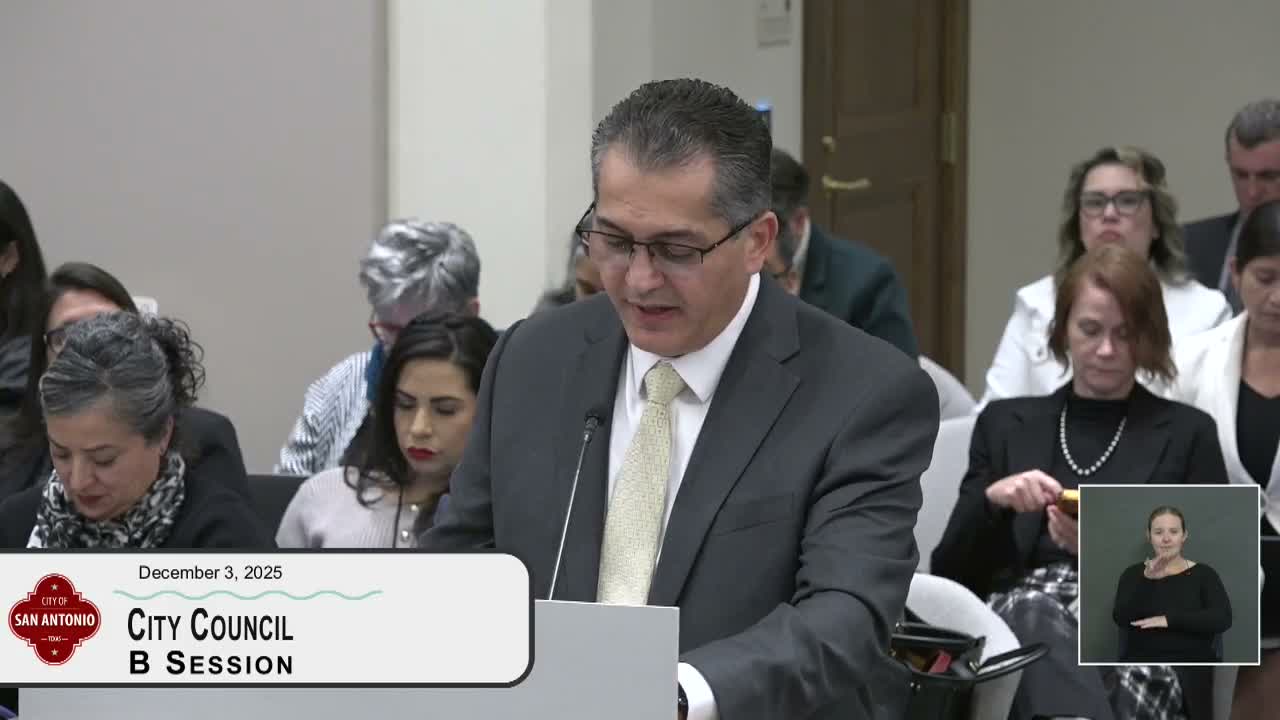
City Development Services Director Amin Thomas on Wednesday presented a draft Code Enforcement Strategic Plan to the San Antonio City Council, summarizing consultant research and community listening sessions and outlining short‑, mid‑ and long‑term actions designed to improve transparency and responsiveness.
Thomas said the plan grew out of a 2023 council consideration request from Councilwoman Adriana Rocha Garcia and a budget‑priority survey in which “50% of the respondents stated that code enforcement did not meet or partially met their needs.” He described a consultant‑led engagement that included 12 staff listening sessions (about 61 staff participants) and 11 community sessions, and said the community voted on five priority focus areas that shaped the plan.
Short‑term objectives (1–6 months) include centralizing code enforcement data in a single SharePoint location for staff, creating regular briefing reports for council offices, holding quarterly stakeholder meetings, and developing automated case‑update notifications so residents can track progress without repeatedly calling council offices. Thomas said staff will also produce easy‑to‑read flyers and tutorials for an improved BuildSA customer portal so residents can view their cases and updates.
Midterm work (6–12 months) calls for rewriting notices in plain language, researching peer cities to balance proactive and reactive inspections, incorporating hardship program information into community events, and expanding staff training so officers can better communicate with residents and help them apply for assistance. Thomas said the department is reviewing geographic assignments to address disparities in response times between districts.
Longer‑term goals include exploring a public dashboard that integrates 3‑1‑1 and BuildSA data, evaluating new technology for automated text/email updates, and assessing staffing needs. Thomas said the department’s last formal staffing study for code enforcement dates to about 2012 and that preliminary estimates suggest a 10–15% staffing increase may be required pending a full analysis.
On vacant lots and abatement, Thomas said the city can summarily abate properties that meet existing criteria (for example, located within 1,000 feet of a school or day care or with grass taller than 48 inches). He said the department increased vacant‑lot contractors from five to nine and dangerous‑premise contractors from three to five to expedite abatement.
Council members broadly praised the outreach and materials but repeatedly pressed staff for specific data and clearer timelines. Council Member White asked for caseload and productivity metrics and whether BuildSA enhancements would meaningfully reduce officer workload; Thomas said the underlying productivity data exists and can be shared while a fuller staffing study is underway. Council Member Munguia and others urged 3‑1‑1 integration so residents and council offices receive more detailed automated updates rather than only a closure notice.
Several council members asked whether the plan’s maximum 18‑month compliance window could be shortened; Thomas responded that the longest timelines reflect statutory due‑process steps and hardship deferrals (for example, a 9‑month hardship deferral), and staff committed to clearly distinguishing what the city can control locally versus what is driven by state law.
Thomas said staff will hold four community briefings (two in person, two virtual) on Dec. 5 and Dec. 11, 2025, and aims to bring the plan to a City Council a session on Jan. 15, 2026 for consideration. He also noted that the department already uses an administrative citation escalation ($300, $500, then $1,000) and that repeated noncompliance can trigger city attorney involvement.
Next steps: staff will share productivity and workload data with council offices, continue work on BuildSA/3‑1‑1 integration options, conduct the scheduled community briefings, and prepare the final materials ahead of the January a session vote.