Get Full Government Meeting Transcripts, Videos, & Alerts Forever!
Get email alerts on the Growth Study topic
No spam. Unsubscribe anytime.
County supervisors demand modeling inputs after growth-study draft adds $33 million for fire capital
Summary
Supervisors in Isle of Wight County flagged a large $33 million fire-protection capital increase between drafts of a county-commissioned growth study and requested the consultant provide modeling inputs, footnotes and agency assumptions before an August presentation.
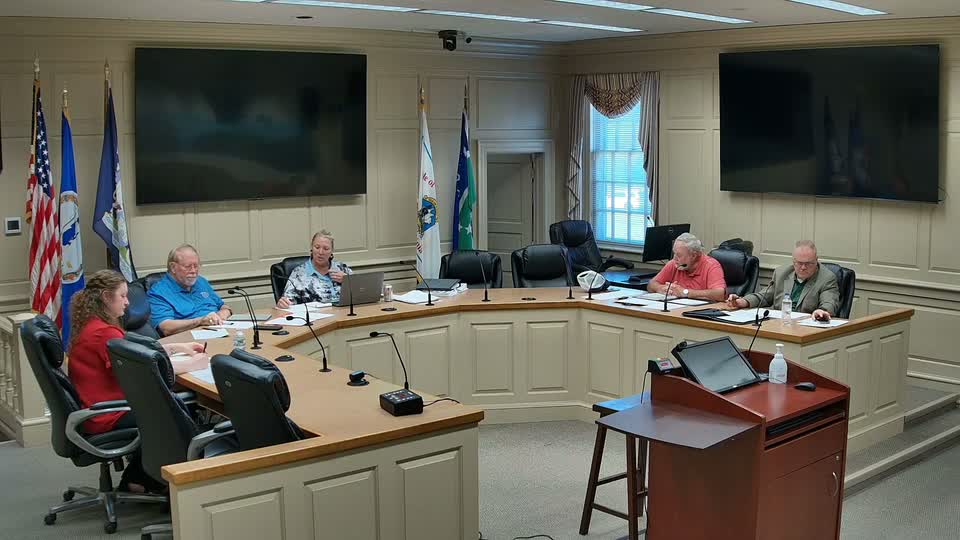
Isle of Wight County supervisors pressed staff to produce the modeling inputs behind a county-commissioned growth-rate study after members found a roughly $33 million increase in projected fire-protection capital between two draft versions.
The study—commissioned by the county to support comprehensive-plan updates and capital planning—presents multiple population and commercial-growth scenarios. Several supervisors said an initial draft showed positive net margins under many scenarios, but a subsequent draft added a step change in capital needs, most notably an added $33 million for fire-protection capital and two new fire stations, which turned earlier favorable scenarios into large projected deficits.
One supervisor said the second draft lacked a clear footnote or methodology to explain that change and asked staff to obtain the consultant's estimating factors. "There's a footnote missing," another supervisor said, urging documentation of the specific inputs that produced the different fiscal outcomes. Committee members suggested the change may reflect department-level feedback (schools, fire/rescue), use of NFPA guidance, or different baseline assumptions, but they asked the consultant to detail what was added or modified.
The board also discussed school enrollment projections; schools hired a separate consultant for enrollment and capacity analysis, and members said the two analyses need to be reconciled. Staff was directed to compile written questions and provide them to the consultant in advance so the consultant can address the modeling approach when she presents to the full board at the upcoming meeting.
Committee members recommended that future reports include estimating factors or a banded set of outcomes (a confidence interval) rather than a single-point estimate so policymakers can see likely ranges and risks. Staff said the drafts have evolved as additional departmental information was received and recommended that the consultant present final recommendations at the August board meeting.
Next steps: staff will collect a set of specific technical questions from supervisors, request the consultant's modeling inputs and footnotes, and seek a joint presentation that covers school projections and the county's growth scenarios.