Lifetime Citizen Portal Access — AI Briefings, Alerts & Unlimited Follows
San Antonio council weighs moving municipal elections from May to November amid tight state deadline
Loading...
Summary
City staff and voting-rights groups urged the council to pass a resolution by Dec. 31, 2025 to move municipal elections from May to November under a recent permissive state law; supporters cited higher turnout and potential cost savings, while council members and school officials raised concerns about cost shifting to independent school districts and logistical impacts.
San Antonio city leaders spent more than two hours on Dec. 10, 2025, debating whether to move city council and mayoral elections from May to November under a recent change in state law that permits — but does not require — municipalities to do so if they act by Dec. 31, 2025.
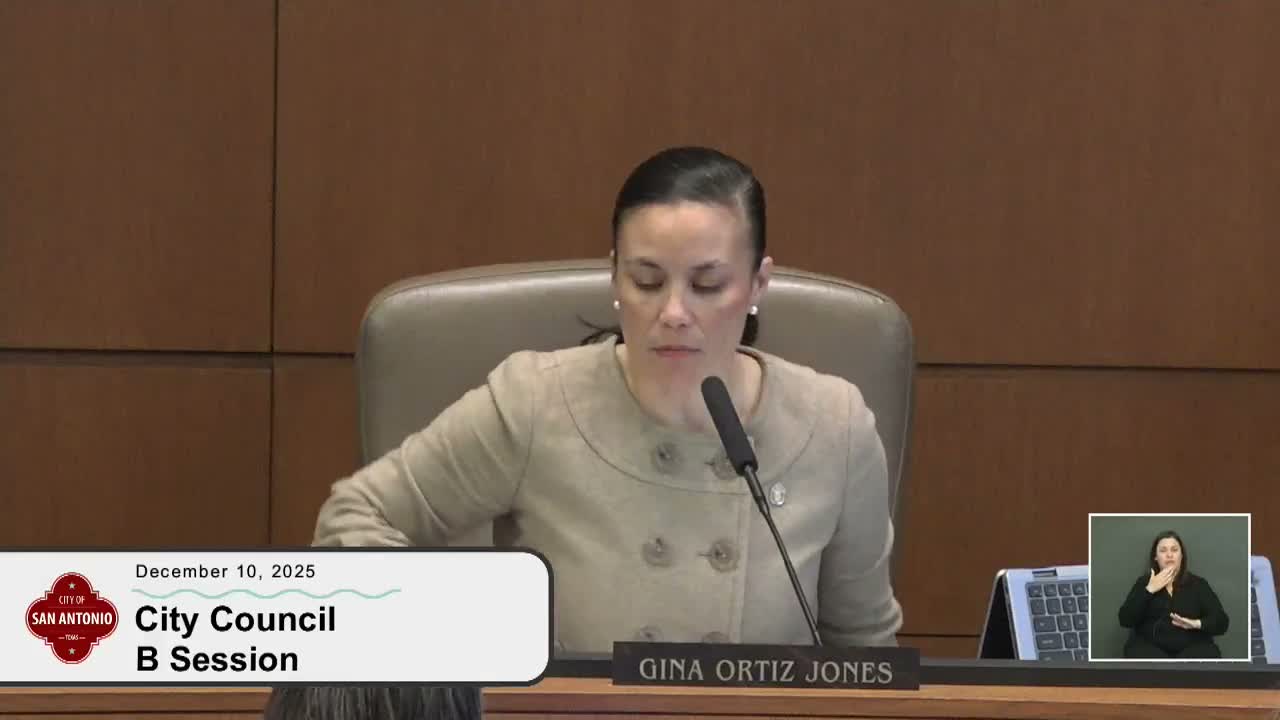
Mayor Jones opened the B‑session by calling the council’s attention to the time‑sensitive option and asking staff to brief the council on legal and operational implications. Assistant City Manager John Buterik told the council the change originated with Dallas-area legislators and that the law is permissive; he warned that, if the council adopts a resolution to move the date, the city charter would need textual updates (for example, the charter currently references taking office in June and a May special-election provision tied to 2031). Buterik also noted runoffs are governed by state election code (no earlier than the 30th day and no later than the 45th day after the general election) and canvass and calendar work would follow.
The staff presentation included historical local election costs: the city spent roughly $633,000 plus a $220,000 runoff in 2023, a $1.3 million charter election in November 2024, and about $470,000 for the 2025 general election with a $1.1 million estimated runoff. Staff said preliminary city estimates put potential savings from consolidation in the range of $800,000 to $1,000,000 but emphasized that the final effect depends on who else is on the ballot and how county cost‑sharing is allocated.
Voting‑rights organizations and community groups urged the council to act. "I am in full support of moving the elections from May to November," said Valerie Reiford, co‑founder and executive director of Radical Registrars, citing turnout and fiscal benefits. Manuel Garza of the Southwest Voter Registration Education Project told the council, "By moving the elections to November, San Antonio will enjoy an increased voter participation compared to May," and urged the council to adopt the mayor’s resolution. Graciela Sanchez of the Esperanza Peace and Justice Center said the change would "expand the voter base" and called it "an opportunity we cannot lose." Professor Melissa Marshall of Rice University presented turnout research and summarized national comparisons, noting in her slides that "on average, those May elections are about 19% turnout, and the November odd years are about 28%." She told the council turnout is driven by how many places hold elections, how many races are on ballots, and how much mobilization activity occurs before November.
Council members split on process and timing. Several members said they support the principle of consolidating elections to boost participation and reduce voter fatigue and costs; others pressed for more analysis and public engagement. Council members and school‑district leaders repeatedly raised the question of cost allocation: county election offices apportion polling costs by the number of registered voters, meaning adding the city to a county‑wide November election could shift or increase costs for some independent school districts (ISDs) and smaller municipalities. Northside ISD representatives warned that added election costs could affect classroom resources and pointed to budget and governance strains if new trustees are seated after a district’s budget cycle has begun.
Council members also discussed whether a public vote (as Dallas did) or additional legislative action to move to even‑year consolidated elections would be preferable. Several members urged outreach and a charter review or ballot measure for residents to weigh in. Others argued the Dec. 18 council meeting offered a lawful and practical opportunity to place the resolution for a council vote before the Dec. 31 statutory window closes.
No final council action was taken on Dec. 10; staff said they would follow up with more detailed cost breakdowns and additional engagement with ISDs and municipalities. The mayor indicated intent to place a resolution for council consideration on the Dec. 18, 2025 agenda. The council later moved into executive session and reconvened, stating that no official action had been taken.
What’s next: staff will provide further analysis of county cost allocations and ISD impacts for council review ahead of the Dec. 18 meeting, when council is expected to consider putting a resolution on the record to move municipal elections from May to November under the permissive state law.