Get Full Government Meeting Transcripts, Videos, & Alerts Forever!
Get email alerts on the Ballpark topic
No spam. Unsubscribe anytime.
Staff outlines downtown minor-league ballpark plan: 4,500 seats, $160M estimate, relocation support and phased development
Summary
City staff presented the downtown ballpark plan: a proposed $160 million project (team equity plus TIRZ-backed bonds), creation of a San Pedro Creek Development Authority to own the stadium, guarantees for phases 1–2 of mixed-use development, and relocation assistance funds for residents affected by redevelopment. Council urged strong community engagement, local hiring provisions, and clearer ROI and bond analyses.
City staff updated the council on a planned downtown minor-league ballpark and its associated mixed-use development, financing plan and relocation measures during the Jan. 14 B session.
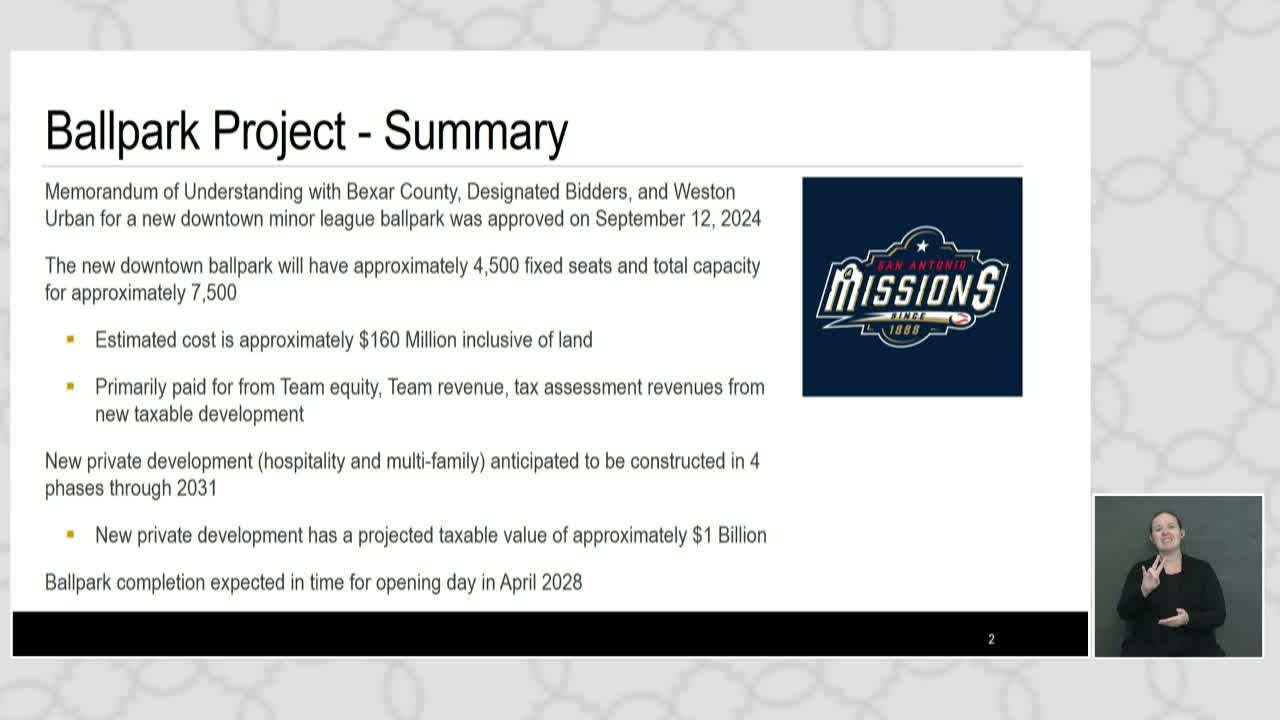
Ben (City staff) summarized the project as a new downtown ballpark with approximately 4,500 fixed seats and total capacity near 7,500. The preliminary estimate presented to the council in prior work was about $160,000,000 inclusive of land and related work; that funding picture included $34,000,000 in team equity plus an anticipated $126,000,000 in bond proceeds supported primarily by incremental property-tax revenues inside the Houston Street Tax Increment Reinvestment Zone (TIRZ). "The estimated cost at that point in time was a $160,000,000 inclusive of land," Ben said. The city created a local government corporation — the San Pedro Creek Development Authority — to own the ballpark and oversee related instruments.
Guarantees, security and conditions
Staff emphasized that bond issuance would be conditioned on guaranteed deliverables: phases 1 and 2 of the developer’s mixed-use plan (combined guaranteed value $575,000,000) must be ready to proceed and phase 2 must have design commenced before the city would issue bond debt for the ballpark. The team will provide certain liquidity and guarantee instruments (two-year line of credit and other owner-backed security) that decline as taxable value materializes.
Community benefits, wages and relocation assistance
The term sheet anticipates a series of community benefits: a team-funded annual capital/maintenance contribution ($250,000), a city contribution of $500,000 from the Houston Street HOT redemption fund for ballpark upkeep, a youth-ticket program and stakeholder days (limited dates for city/county use), and the 1888 Baseball Foundation committing $200,000 annually for youth and homeless-veteran programs. Ben said the team agreed to a wage commitment tied to the city’s minimum entry wage and to participate in local hiring and SABETA (local participation) processes; staff said Ban-the-Box language was included during negotiations.
Relocation and Nelson Wolff Stadium reuse
Ben reported that Western Urban’s relocation plan accounts for up to 381 units across three phases; 189 units in phase 1 have been relocated already and the developer distributed $152,000 for relocation; the city distributed $74,000 and about $2.754M remains for phases 2–3. Relocation assistance included up to $2,500 per eligible household in the initial relocation plan. Staff proposed starting a consultant-led concept and community engagement effort for reuse of the current Nelson Wolff Stadium site, with an RFQ to Audit Committee in March and draft consultant output by September–October.
Council reaction and follow-up requests
Council members broadly supported the potential economic upside but raised concerns that staff must address: ensuring robust community engagement (especially in nearby neighborhoods and small-business corridors), detailed displacement and relocation accounting, clear bond-feasibility and ROI analysis tied to PFZ/TIRZ allocations, and accountability mechanisms (contract incentives/penalties for the executive program manager). Council members also asked staff to clarify the timing of bond issuance and to show where costs and reserves will sit in offering documents.
What happens next: staff said the team will lead a bond feasibility study (with city input) and hoped to begin consultant engagement in February with a draft in April and final report in June. The council will be asked to consider definitive agreements and potential bond authorization in May–June; staff said phase 1 development readiness is a gating condition to any bond market issuance.