Get Full Government Meeting Transcripts, Videos, & Alerts Forever!
Get email alerts on the Energy Solar topic
No spam. Unsubscribe anytime.
Board approves two-year extension for New Leaf Energy’s 3 MW Courthouse Highway solar permit
Summary
The Isle of Wight County Board of Supervisors approved a two-year extension to New Leaf Energy’s conditional use permit for a 3-megawatt community solar facility at 16419 Courthouse Highway, requiring the project be established by Nov. 30, 2027 and barring further extensions, after a public hearing and planning‑commission recommendation.
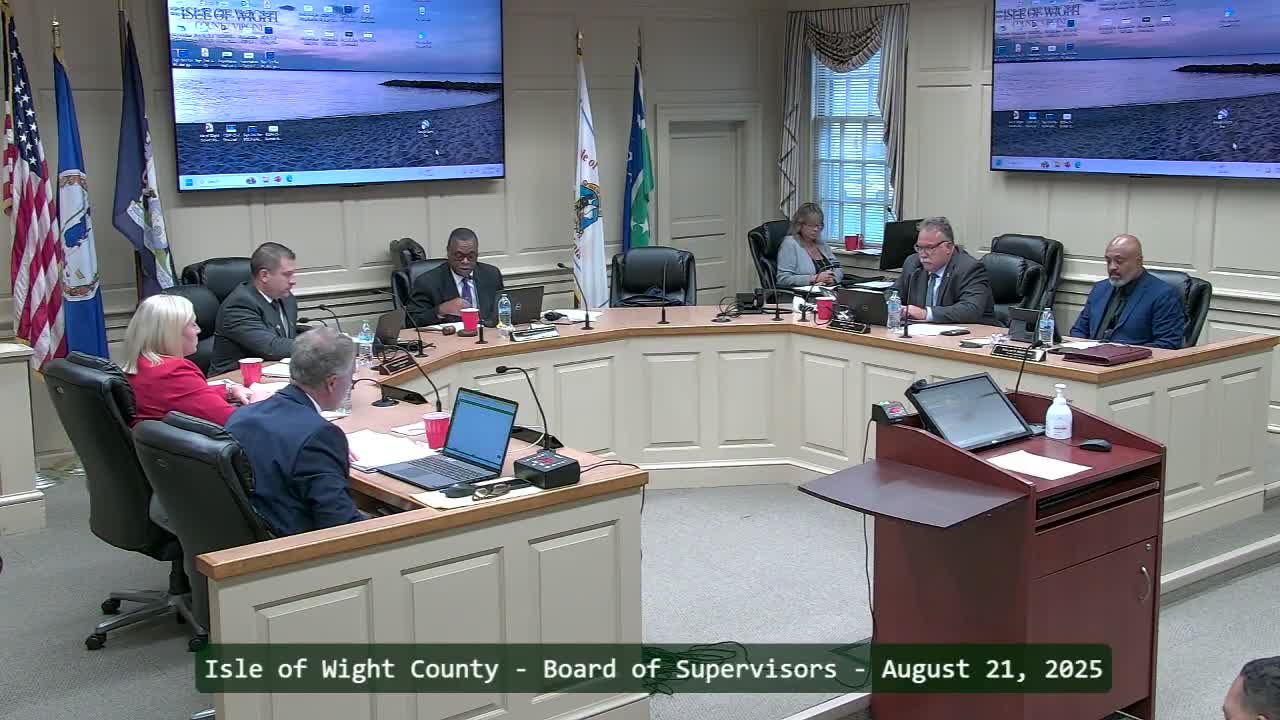
The Isle of Wight County Board of Supervisors voted to extend the conditional use permit (CUP) for New Leaf Energy’s 3‑megawatt solar generation facility at 16419 Courthouse Highway, allowing the developer two additional years to begin work.
Planning staff said the permit, originally approved in November 2023, covers an 18‑acre site and is part of Virginia’s community/shared‑solar program. Trenton Blow of planning staff told the board the company was placed on Dominion Energy’s shared‑solar wait list and asked for extra time to be removed from that list and secure program capacity. Staff recommended approval with two conditions: no further extensions and that the use be established on the property by Nov. 30, 2027.
Jesse Robinson, project developer with New Leaf Energy, described the request as an administrative extension tied to the wait list. "We're asking for 2 years just to give us flexibility if that goalpost moves farther than we're thinking," Robinson said, explaining New Leaf is fourth on the local list for shared‑solar capacity and expects capacity might be released in 2027.
Speakers at the public hearing were mixed. The property owner told the board the developer had made progress and requested the extension to permit orderly development, while residents expressed both opposition and support. One opponent urged caution about further solar approvals and argued market and subsidy timelines create business risk. A nearby resident who supports the project said the parcel was already approved two years ago and that tonight’s action concerned only the permit’s timeline.
The planning commission had recommended approval with staff conditions (6–3). After public comment and board questions about what constitutes being "established" under a CUP (staff said a reviewed and approved site plan—rather than full construction—satisfies the term), the board voted to approve the amendment to the conditional use permit with the staff’s two recommended conditions.
The board’s action extends the date by which the use must be established to Nov. 30, 2027 and includes a clear statement that additional extensions are not allowed under the approved amendment. The county stressed that subsequent site‑plan review and all standard departmental approvals remain required before construction can begin.
What’s next: the project will proceed to required site‑plan reviews and any department-level approvals. If the developer later proposes changes outside substantial conformity with the CUP, it must return to the board.