Get Full Government Meeting Transcripts, Videos, & Alerts Forever!
Get email alerts on the Rezoning 3406 Roosevelt topic
No spam. Unsubscribe anytime.
Council approves rezoning for Joel’s Collision at 3406 Roosevelt with conditions after heated public debate
Summary
After extended public comment and opposition from neighborhood and preservation groups, San Antonio City Council approved rezoning for Joel’s Collision at 3406 Roosevelt Avenue with conditions on lighting, signage, hours and required permitting and HDRC review.
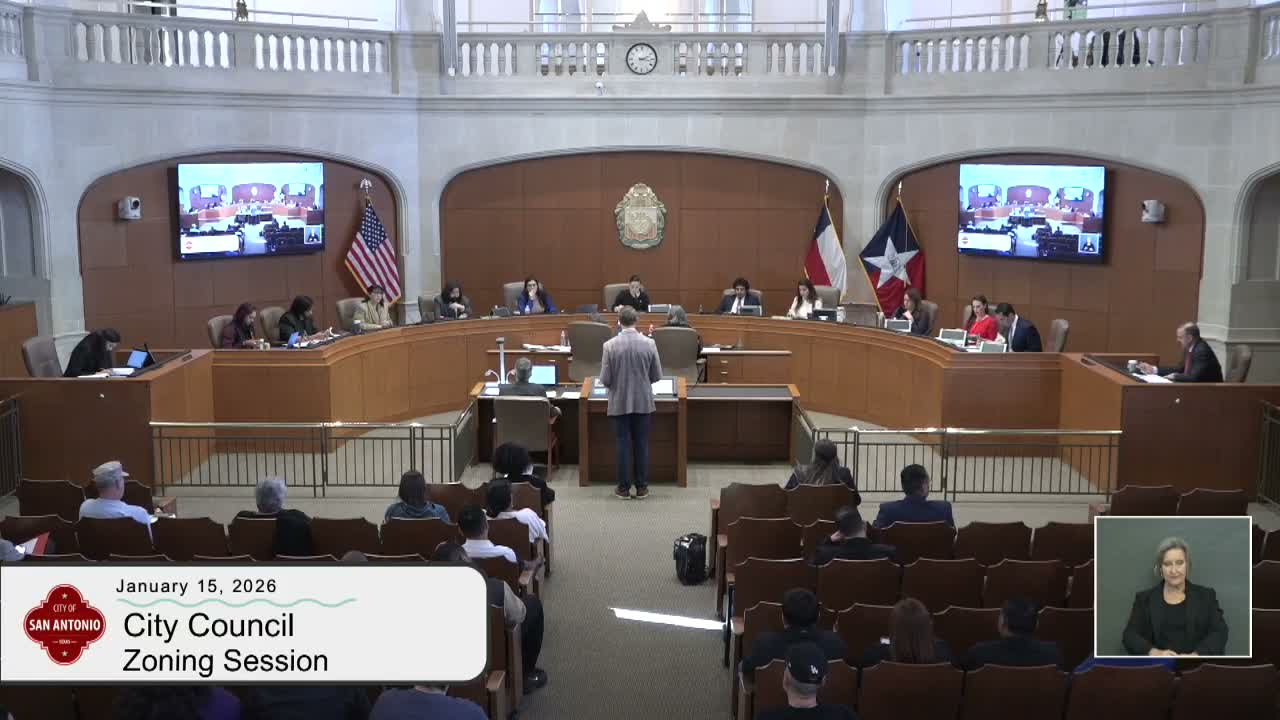
San Antonio — The City Council on Jan. 15 approved a zoning change for 3406 Roosevelt Avenue so Joel’s Collision can operate and bring the site into compliance, after more than an hour of public comment that included sharp objections from preservationists and neighborhood leaders.
Joel Ferdin, who identified himself as the owner of Joel’s Collision, told the council the site has operated as an auto body facility for decades and that he’s invested about $1.5 million in safety and building improvements since acquiring it last September. “We just want to improve the look and the appearance of the building … and modernize the shop,” Ferdin said during public comment, describing removal of a 37‑year‑old paint booth and installation of a three‑hour firewall and updated exhaust that the applicant says meet International Fire Code and International Building Code standards.
Opponents, including the Mission San Jose Neighborhood Association, the Conservation Society of San Antonio and multiple residents, argued the property sits within the World Heritage buffer near Mission San Jose and that unpermitted additions, visible smoke stacks and electrified fencing have harmed the viewshed and set a dangerous precedent. “This property was developed into new non‑compliant elements without following the city’s procedures,” said Louis Vetter, president of the Conservation Society of San Antonio, urging the council to deny the rezoning.
Jane Henry of the Mission San Jose Neighborhood Association detailed code‑enforcement citations and said the site’s current condition is incompatible with long‑standing protections for the mission area. Henry asked the council to require removal of illegal additions rather than approve new zoning that could codify noncompliance.
Councilmember Villagran (District 3) moved to approve the rezoning with conditions, emphasizing both the need to protect the historic mission area and the council’s interest in supporting established local businesses that seek to come into compliance. Staff clarified that Development Services Department permitting remains required and that Historic and Design Review Commission (HDRC) review is not superseded by the zoning change. The motion to approve with the listed conditions passed by voice vote.
The conditions read into the record and attached to the zoning approval included installation of downward‑facing lighting, prohibition on temporary signage, limits on hours of operation (weekday and Saturday hours as recommended by staff), a prohibition on external sound systems or live music, and solid screening fencing along Woodhull Drive. Staff also noted the zoning commission’s recommended conditions and that the Mission San Jose Neighborhood Association’s opposition triggers a super‑majority requirement.
What happens next: the approval does not eliminate building permits, HDRC review, or other regulatory steps; Development Services must approve equipment and exhaust permitting and the applicant must address outstanding code‑enforcement issues through the normal permitting and inspection processes. The council’s action grants the zoning change with the conditions listed and leaves implementation and compliance to the appropriate city departments.