Get Full Government Meeting Transcripts, Videos, & Alerts Forever!
Get email alerts on the Stormwater topic
No spam. Unsubscribe anytime.
Council hears stormwater revenue-bond options and modeled fee impacts on households
Summary
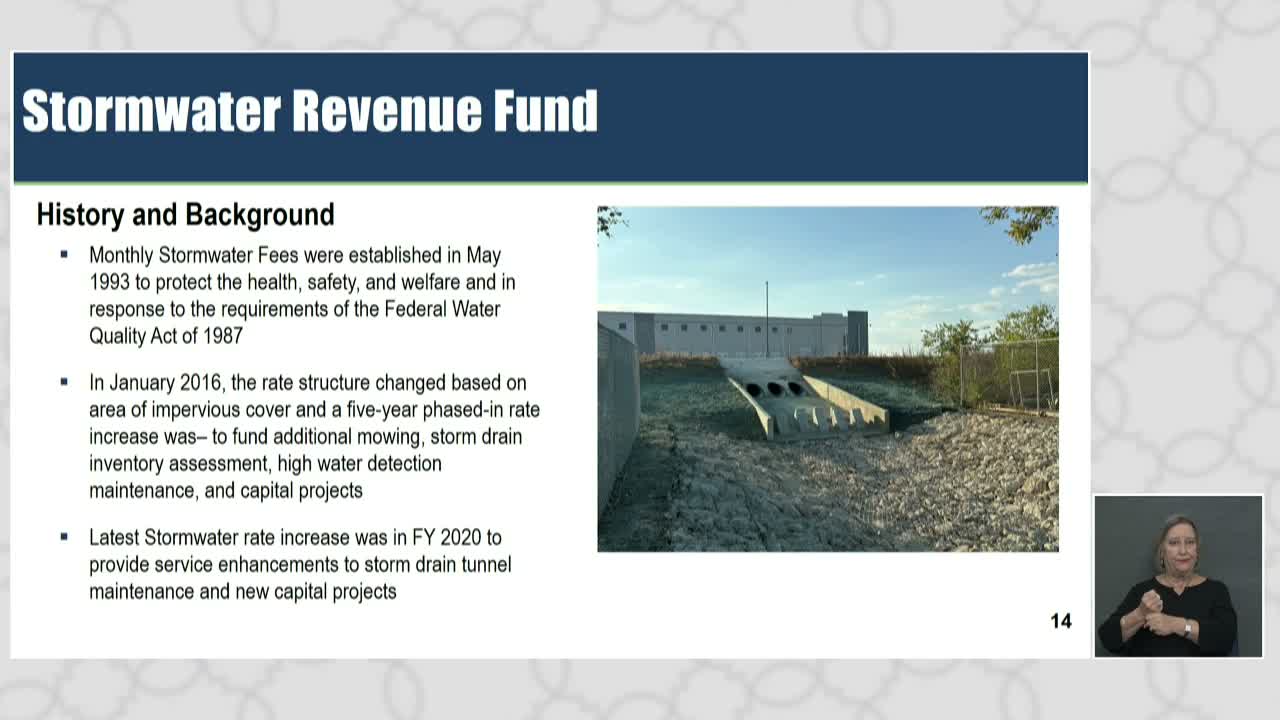
Staff outlined history and structure of the stormwater fund, presented four rate scenarios that could expand stormwater bonding capacity from about $10M (no increase) to as much as $174M over 25 years, and quantified household impacts for a typical tier-2 residential account. Council members requested district-level breakdowns and nonresidential analyses.
City staff told the council that the stormwater fund could be leveraged to add capital capacity but that doing so hinges on the structure and size of future rate increases.
Art Reinhardt of Public Works told councilmembers the city's citywide drainage need is "still close to about $4,000,000,000 of drainage need," while the stormwater fund today generates roughly $56.8 million in revenue against about $59 million in expenses and about $7 million in debt service. Staff calculated that with no rate increase and a 25'year revenue-bond term, bonding capacity is small (~$10 million), but staged rate scenarios (for example, 2% annual increases over five years, or larger initial hikes followed by smaller increases) could generate $106.7 million to $174.3 million in stormwater bonding capacity.
Staff walked the council through the fee structure used today: residential accounts are assigned to three tiers by impervious-area ranges (tier 2 currently pays about $4.94 per month, roughly $60 per year), while nonresidential accounts are priced per-thousand-square-feet plus a base fee. Staff said about 366,000 accounts are residential and roughly 50,000 are nonresidential; nonresidential accounts account for a majority of impervious cover and around 55% of fund revenue.
On household impacts, staff showed examples for a tier-2 customer: one modeled scenario would add about $1.20 to annual charges in 2027, rising under larger scenarios to multi-dollar annual changes (examples in staff modeling showed up to about $8.16 in annual impact for one aggressive scenario over the five-year modeling window). Multiple councilmembers asked for a district-by-district revenue breakdown and asked whether nonresidential rates could be adjusted to shift the burden away from households.
Why it matters: councilmembers noted that stormwater projects are large and that postponing rate adjustments has left a substantial capital backlog; they weighed equity concerns about regressive effects on households versus the public-safety and property-protection benefits of accelerated drainage investment.
Next steps: staff committed to provide more granular district-level revenue and account breakdowns, pro-forma showings of operating vs capital composition of any rate increase, and options to change nonresidential rate structure before council sets any rate or bond strategy.