Get Full Government Meeting Transcripts, Videos, & Alerts Forever!
Get email alerts on the Bond Capacity topic
No spam. Unsubscribe anytime.
San Antonio staff present smaller bond-capacity scenarios, urge policy direction
Summary
City staff told the City Council that historic tax-rate and flattened property-value growth have reduced traditional bond capacity; they presented three scenarios (roughly $625M, $1B and $1.2B) and asked council for policy feedback on tax-rate flexibility, timing and priorities. No vote was taken.
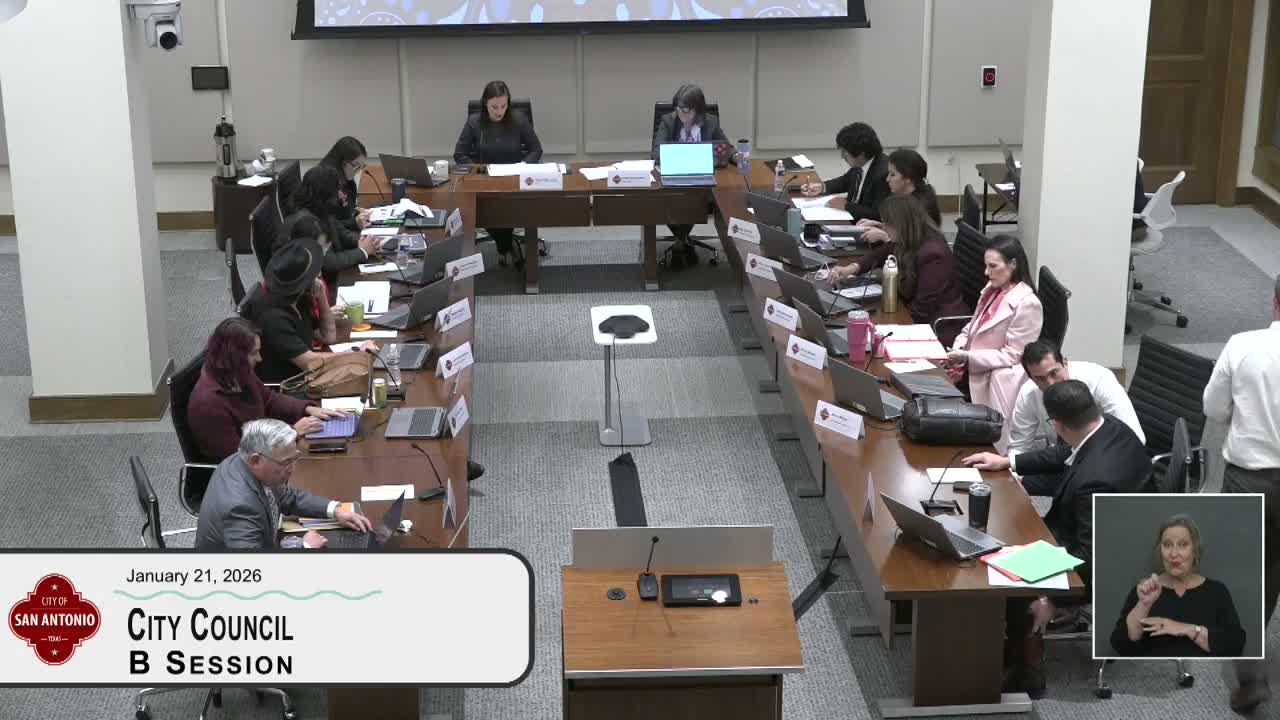
City staff told the San Antonio City Council on Jan. 21 that the city's traditional municipal-bond capacity has fallen from recent highs and presented three scenarios for a future bond program, asking councilmembers for policy feedback rather than voting on a size.
In a presentation led by Troy (city financial staff), members learned that long-term assumptions'including a debt-service tax rate that has remained at 21 cents per $100 of taxable value since 2004 and modest near-term growth in taxable values'drive the city's borrowing capacity. Troy said the modeling that produced a prior $500 million estimate remains in place and that staff provided alternate scenarios that would require different growth or tax-rate flexibility to reach higher amounts.
Troy told council: "that 500,000,000, those assumptions have not changed. It's still 500,000,000." He explained that a scenario timed no sooner than a May 2027 election could yield about $625,000,000 in general obligation capacity under current assumptions; a $1,000,000,000 program would require sustained taxable-value growth to about 3.25% beginning in 2028 or greater flexibility with the debt-service tax rate; a $1,200,000,000 scenario assumes roughly 3.5% growth.
Why it matters: the size and structure of any bond program determine what projects the city can fund for streets, drainage, parks, libraries and public facilities. Councilmembers repeatedly pressed staff for more district-level revenue and needs data and for clear guardrails on whether and when the city would use tax-rate flexibility rather than rely solely on property-value growth.
Council reaction and context: several councilmembers signaled conditional support for higher scenarios if accompanied by strict prioritization, explicit equity measures and project-level scoping. Council member Viagaddan said, "I think scenario number 2 is the one I feel most comfortable about," and asked staff to return with further analysis. Other members warned that giving the city latitude to raise the debt-service tax rate risks making increases permanent unless strong policy limits are adopted.
Next steps: staff said they will return with more detailed project scoping, district-by-district revenue breakdowns and financial policy recommendations for when and how to use tax-rate flexibility. No formal action or vote occurred at the session.