Get Full Government Meeting Transcripts, Videos, & Alerts Forever!
Get email alerts on the Municipal Utility Districts topic
No spam. Unsubscribe anytime.
San Antonio briefing draws widespread opposition to Lennar’s Guadalupe Ranch MUD ahead of Feb. 5 council vote
Summary
At a Jan. 22 special session, City of San Antonio staff briefed council on a developer petition seeking consent for Bexar County MUD No. 2 (the Guadalupe/Guadalote Ranch project). More than two dozen speakers — residents, scientists and local officials — urged denial, citing aquifer contamination risks, emergency‑access and infrastructure costs; SAWS said it ‘takes no position’ but has negotiated conditions.
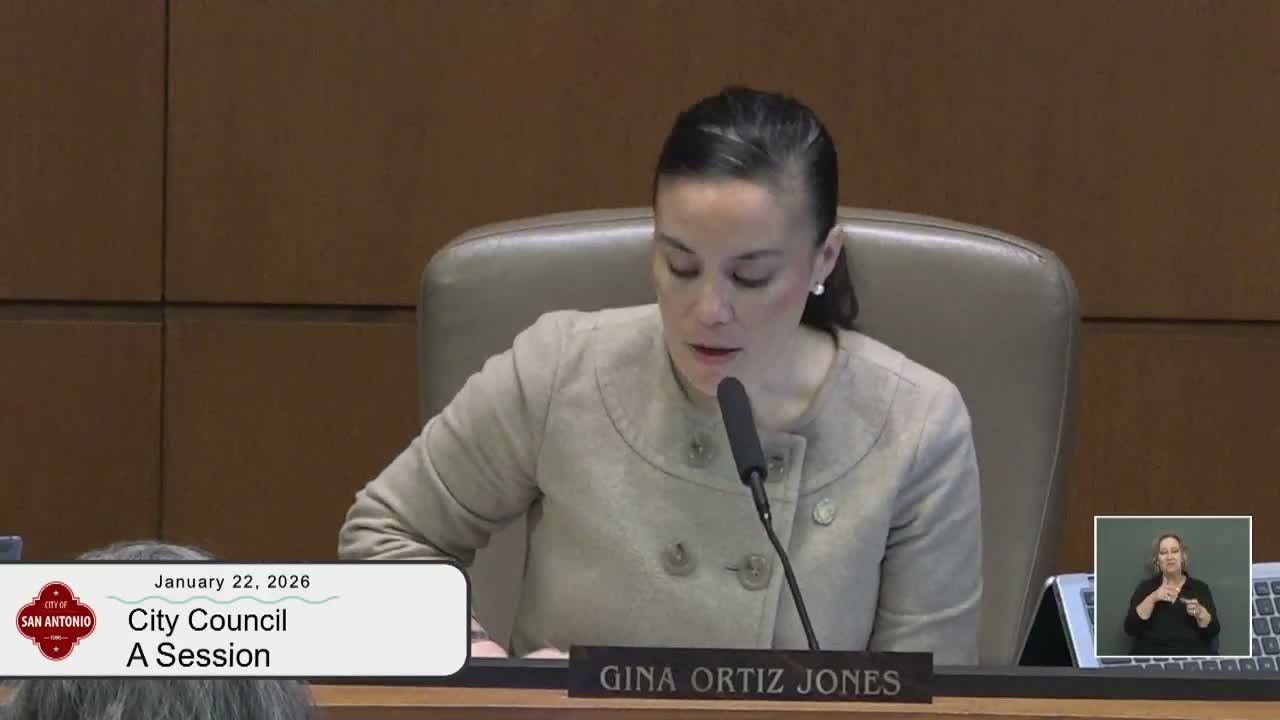
A special City of San Antonio session on Jan. 22 drew hundreds of residents and more than two dozen public speakers who urged the council to reject a developer’s request for consent to create a municipal utility district to serve the proposed Guadalupe Ranch development in the city’s extraterritorial jurisdiction.
City staff opened the briefing by describing the petition to form “Bexar County MUD No. 2,” a proposed financing tool the developer says would fund on‑ and off‑site infrastructure for an approximately 1,160–1,167‑acre site near Scenic Loop Road and Babcock Road. Staff said Lennar Homes of Texas plans the project and that the site is inside San Antonio Water System’s water Certificate of Convenience and Necessity (CCN) but not inside any sewer CCN. Staff said the petition triggered a 90‑day clock that sets a Feb. 5 council meeting as the date to consider consenting to the MUD and an associated development agreement.
The briefing laid out draft development‑agreement terms under negotiation, including a proposed $150 million cap on bond issuance, third‑party conservation easement requirements, limits on impervious cover and wastewater service development controls such as requiring an A‑level operator for any on‑site wastewater plant, monitoring and testing provisions, and a post‑annexation surcharge option for the city. Staff repeatedly told council that approval of consent with an executed development agreement is the only option that would allow the city to bind certain conditions to the land.
During the afternoon public‑comment period, experts and residents focused on water‑quality and safety risks. Kate Hall Feist of the Scenic Loop / Helotes Creek Alliance warned that “this life source is now at risk” and said thousands of residents had filed opposition with the Texas Commission on Environmental Quality (TCEQ). Geologist Stuart Birnbaum of UTSA testified that the Trinity Glen Rose and Edwards aquifers are in hydrologic communication and that karst and faulting could offer conduits for contamination. Multiple speakers repeated a commonly used figure that the proposed wastewater plant could discharge about 1,000,000 gallons a day into the Helotes Creek watershed; at least one speaker cited a larger figure from the development materials.
Speakers raised additional concerns: Lynette Munson said a public‑records request to the Bexar County Fire Marshal returned no documentation of fire‑safety review or approval for a plan that, she said, relies on a single ingress and egress for thousands of homes. Residents and Gray Forest officials warned of flooding, road‑capacity and long‑term maintenance costs that could fall on taxpayers. Several commenters and one coalition representative noted a lawsuit filed in Travis County seeking review of a TCEQ wastewater permit tied to the project.
Donovan Burton of the San Antonio Water System (SAWS) spoke as a resource witness and said SAWS “takes no position on the MUD.” He told council SAWS negotiated nine conditions into its service agreement and believes many of the SAWS water‑source concerns have been mitigated under those conditions, while acknowledging subsurface geology is complex. SAWS senior counsel Keith Martin clarified that SAWS is not required to provide sewer service in that area because it is outside SAWS’s sewer CCN; SAWS could, however, participate in negotiations and build infrastructure if parties reach agreement.
Council members engaged an extended Q&A with staff and SAWS about procedural timing and which protections would remain if the council denies consent or takes no action. Staff said some protections are embedded in existing settlement or SAWS agreements and would survive, while other development‑agreement controls (the '15 draft controls' shown in staff slides) would be off the table without council consent; staff committed to providing a clear list identifying which controls would remain and which would be removed by the end of the week.
Several council members said they were leaning against consenting to the MUD in its current form. No vote was taken at the session; council members were scheduled to consider the petition and any executed development agreement at a regularly scheduled meeting in February. Staff listed due‑outs for legal and staff teams, including case studies of similar TCEQ outcomes and the requested breakdown of which controls would persist if the council votes no.
The special session adjourned at 11:41 a.m.