Get Full Government Meeting Transcripts, Videos, & Alerts Forever!
Get email alerts on the Law And Policy topic
No spam. Unsubscribe anytime.
San Antonio staff say state law constrains city—cooperation with ICE; SAPD stresses limited role
Summary
City staff told the San Antonio City Council on Jan. 22 that Texas SB 4 requires cooperation with federal immigration authorities in certain circumstances, while the San Antonio Police Department said its role is public-safety support, not immigration enforcement, and described limited task-force assistance and data on detainers.
San Antonio — City staff and the San Antonio Police Department told the City Council on Jan. 22 that state law and operational practice largely limit the city's discretion in responding to requests from federal immigration authorities.
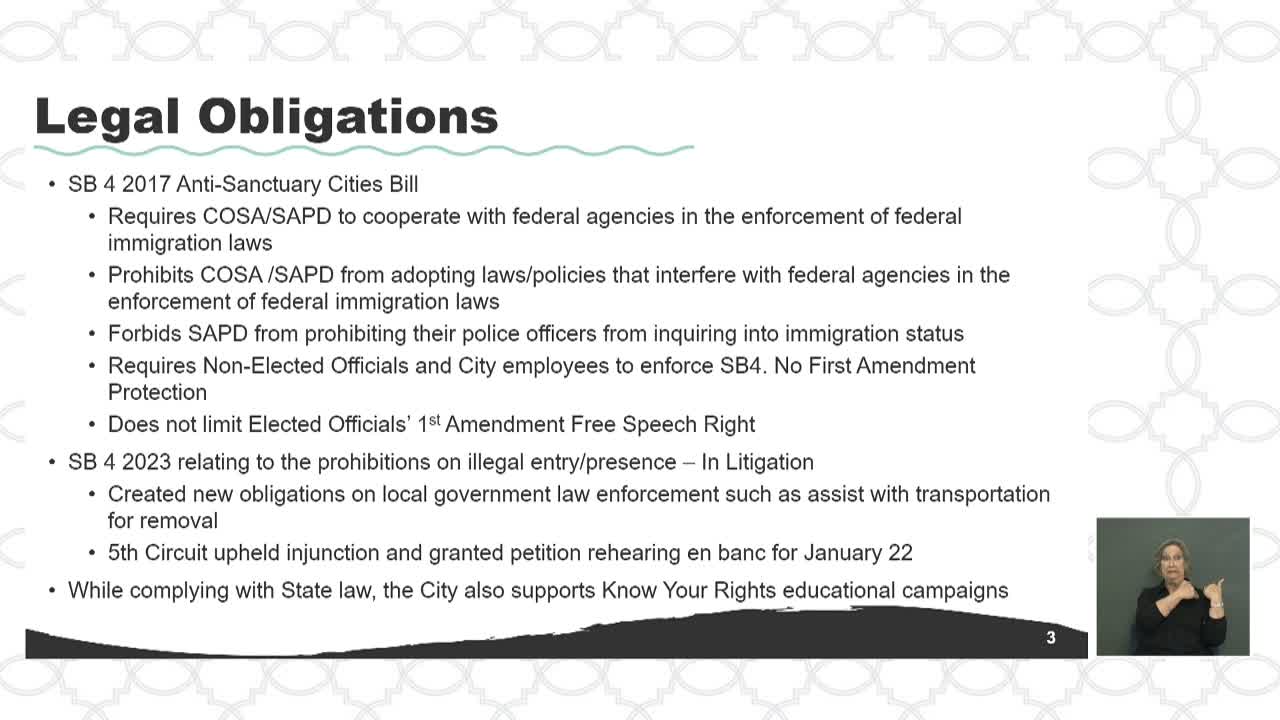
The city attorney's office briefed council members on SB 4, a Texas law passed in 2017 that staff described as requiring municipal cooperation with federal immigration enforcement and forbidding local policies that would —interfere— with federal actions. Andy, the lawyer leading the briefing, said the statute leaves several terms undefined and warned the council that —we are going to comply with SB 4.—
Chief McManus, who led the SAPD presentation, said SAPD —does not enforce immigration laws— and that the department's work with federal partners is focused on serious crimes, including narcotics, firearms and human trafficking. He said SAPD participates in multiple multi-jurisdictional task forces and that task-force officers are deputized to operate beyond San Antonio when required. —These task forces are focused on serious crimes,— he said, and noted the department currently participates in 18 task forces.
Deputy City Manager Maria Villagomez reviewed department data for calendar year 2025, reporting that SAPD received roughly 2.1 million calls and was dispatched to about 1.8 million calls. Of those, staff identified 66 calls that referenced the word —immigration— and 258 reports that used the term. The department said it arrested more than 51,000 people in 2025 and that ICE issued 111 detainers.
SAPD officials described how the department distinguishes administrative immigration warrants from judicial warrants and said officers are not authorized to make arrests solely on the basis of an administrative ICE warrant. Chief McManus said officers assigned to federal task forces remain under SAPD management for the duration of their assignments and that requests for SAPD assistance to federal operations are rare and typically limited to scene security or perimeter control.
Council members asked a series of clarifying questions about which SAPD units are used in federal requests, who signs off on deployments, whether the city seeks or receives reimbursement for officers' time, and how often SAPD officers encounter administrative warrants. Staff said supervisors make deployment decisions, the city had not received reimbursement for the described 2025 requests, and that administrative-warrant activity has increased in federal systems and is being monitored.
No formal action was taken by council during the briefing; staff said they would provide additional follow-up data and options requested by council members.