San Antonio council rejects developer-backed MUD for Guadalupe Ranch after hours of testimony on aquifer risks
Loading...
Summary
After more than five hours of public testimony and technical briefings, the San Antonio City Council voted down two developer-backed items that would have allowed creation of Bexar County Municipal Utility District No. 2 (the Guadalupe Ranch MUD) and an associated development agreement, citing widespread community and scientific concern about water quality in the Helotes Creek/Edwards Aquifer watershed.
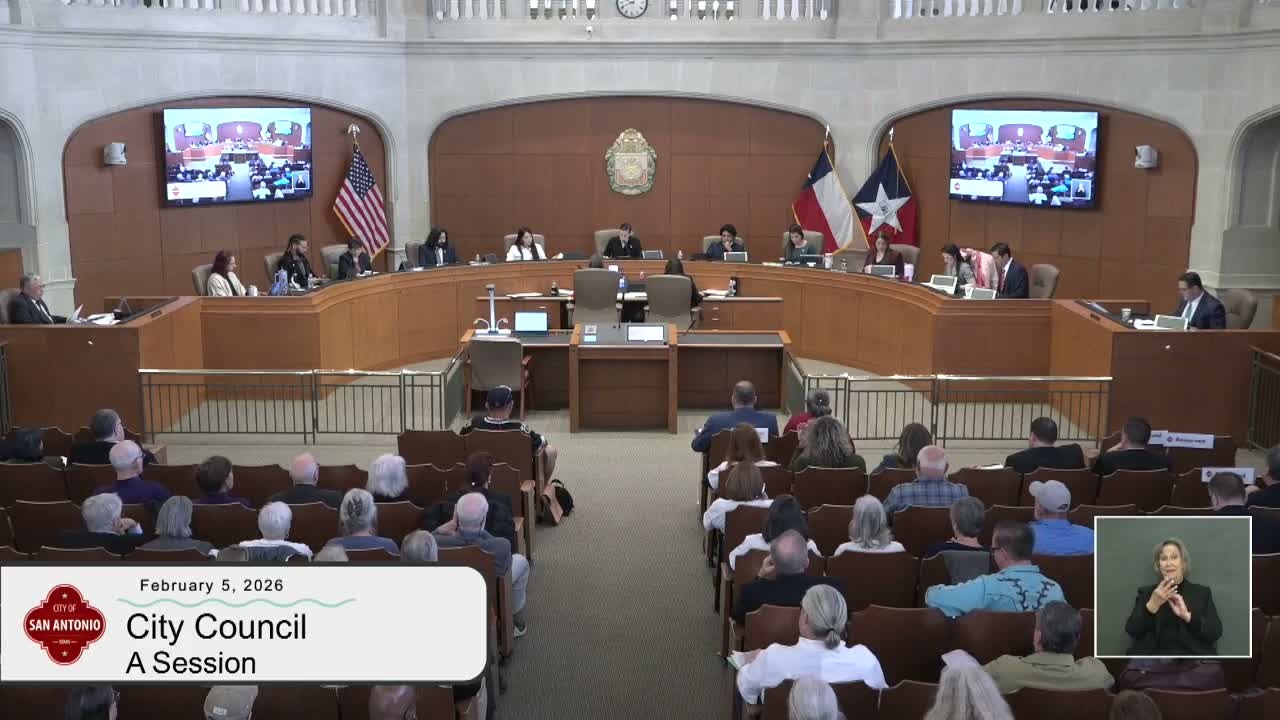
San Antonio — The San Antonio City Council on Feb. 5 declined to give the developer consent needed to create a municipal utility district (MUD) to finance the proposed Guadalupe Ranch subdivision and also rejected an associated development agreement, after hours of public testimony calling the project a threat to the Edwards and Trinity aquifers.
Bridgette White, director of the city Planning Department, told the council the site is roughly 1,160 acres in Bexar County’s extraterritorial jurisdiction and that the developer planned up to 3,000 single-family homes and an on-site wastewater treatment plant. White said water-quality protections negotiated with the San Antonio Water System (SAWS) and terms from a 2024 settlement would remain in certain scenarios, but that several additional protections would be available only in a signed development agreement—which the developer had told staff it would not sign.
Residents, scientists and elected officials urged council members to deny consent. “This is not a philosophical debate. It is a legal, scientific, and moral one,” said Randy Newman of the Pilots Creek Alliance, urging a no vote and pointing to statutory protections under the Texas Water Code. Hydrogeologists who testified cited dye-tracing studies and the 2020 Southwest Research Institute evaluation, telling council that effluent applied over karst terrain can reach recharge zones rapidly. Ronald Green, a groundwater hydrologist and senior member of the Southwest Research Institute team, said, “The study concluded that regardless of the type of facility, the impact to water recharge to the Edwards Aquifer is dependent on the amount of mass load discharge to the environment.”
SAWS’ Donovan Burton told the council the utility “takes no position on this MUD district” but described the negotiated contractual conditions as stringent and aimed at high levels of treatment. Burton added SAWS had included water-quality conditions intended to limit environmental risk, and city staff pointed to nine protections negotiated with SAWS plus ten conditions from the settlement agreement that would remain in some circumstances.
Council debate focused on three main concerns: the scientific question of whether the Trinity and Edwards aquifers communicate beneath the site; the sufficiency and enforceability of proposed water‑quality conditions for an on‑site wastewater plant over karst terrain; and the MUD structure itself, which creates a developer‑governed taxing entity and can issue bonds. Several members warned that a MUD’s governance and permanent taxing authority raise long-term fiscal and accountability questions for residents.
After deliberation the council voted separately on the two items. The motion to approve item 4 (consent to creation of Bexar County MUD No. 2) failed. A separate motion to approve item 5 (approval of the associated development agreement) also failed.
What happens next: Denial of city consent does not end the project. If the city denies consent or takes no action, the developer could pursue a petition with the Texas Commission on Environmental Quality; staff explained that outcome would begin different timelines for negotiations with SAWS and potential TCEQ review. The issue also remains the subject of a pending legal appeal of the wastewater permit in Travis County, testimony noted.
Votes at a glance: The council approved routine minutes and passed the consent agenda earlier in the meeting. Motions to approve items 4 and 5 (the MUD and the development agreement) failed on separate council votes.
The meeting record shows wide public opposition, repeated technical critiques of SAWS’ analysis, and requests for additional independent hydrologic study. The council’s decision keeps the city’s leverage to seek stronger, enforceable protections but does not by itself prevent the developer from pursuing state approvals or alternate financing paths.