
Virginia subcommittee continues HB 493 after hours of debate on electronic absentee returns for blind and overseas voters
Get AI-powered insights, summaries, and transcripts
Sign Up Free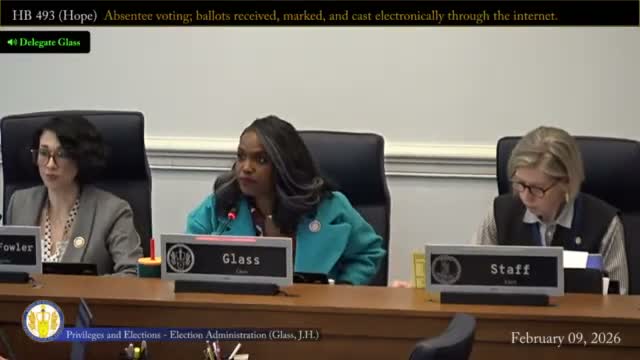
Summary
The House Privileges & Elections Subcommittee heard hours of testimony for and against HB 493, which would require a uniform electronic portal allowing voters with visual or print disabilities and covered overseas/military voters to mark and return absentee ballots; the subcommittee voted to carry the bill over to FY 2027 for further work.
Delegate Charniele Herring (Delegate Hope in transcript), the bill uthor, told the House Privileges and Elections Subcommittee that HB 493 would require the Department of Elections to provide a uniform electronic tool so voters with visual impairments or print disabilities, and covered overseas and military voters, can receive, mark and return absentee ballots electronically.
The sponsor said the portal is not "Internet counting," explaining that "Every electronic ballot is printed onto a physical record" and that printed record creates a "100% paper audit trail" that election officials would scan and count. She said the portal would include multifactor authentication and "meets CISA and NIST standards." The sponsor also moved the bill—nactment date to January 2028 to allow the Department of Elections and vendor transition time (substitute introduced SEG 020—nd).
Supporters ranged from disability-rights groups to veterans. Bonnie O'Day, legislative chair of the National Federation of the Blind of Virginia, testified that the group's "400 members across the state strongly support HB 493" and described practical barriers blind voters face with printing, mailing and finding accessible transportation. Doug Powell, president of the American Council of the Blind of Virginia, recounted locked PDFs and envelope-identification problems that delayed or left ballots pending and urged a uniform, accessible return option.
Opponents raised cybersecurity and secrecy concerns. Susan Greenhall, senior adviser for election security at Free Speech for People, said she "agree[d] with the intent" but could not support what she characterized as internet voting and warned federal agencies have identified security risks. Dr. Clarabel Wheeler and representatives from Public Citizen and Verified Voting cited examples of online-voting failures and warned that printing a ballot at the office after an electronic transmission does not eliminate remote attack vectors.
Rather than vote the bill forward this session, the subcommittee accepted a motion to continue HB 493 to FY2727 for further work and stakeholder discussion. The chair called a voice vote and "that motion carries." The record shows extensive written and oral testimony on both sides; the sponsor and several members said they want additional technical details and stakeholder negotiation before the measure advances.
What's next: HB 493 will be carried into the next year for further study and drafting; the sponsor signaled willingness to meet with stakeholders to refine technical, security and implementation details.