Subcommittee advances a slate of civil bills: restitution payments, child-support pilot, protective-order relief, driver-license reforms and others
Loading...
Summary
The House civil subcommittee on Feb. 10 moved multiple civil and family-law bills forward. Notable outcomes: HB 1235 (online restitution payments) reported 8–0; HB 1346 (child-support employment pilot) carried over to 2027 for further work; HB 440 (repeal of license suspensions for low-income debtors) reported and referred to Appropriations 5–3; HB 1363 (protective-order payment authority) reported 9–0. A block of probate and procedure cleanup bills also reported unanimously.
The civil subcommittee considered a broad docket of bills on Feb. 10 and reported a number of measures with either unanimous or majority support.
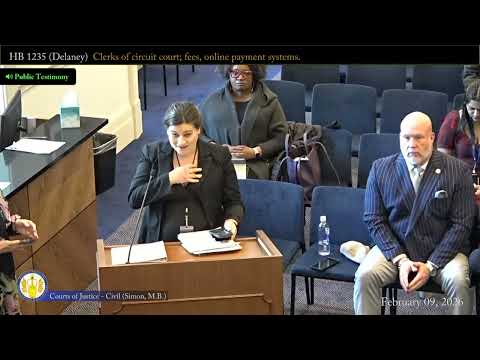
Early in the session the panel adopted a substitute for HB 1235, sponsored by Delegate Delaney, narrowing an original online-payments proposal to require courts to accept restitution payments online and directing the Office of the Executive Secretary to convene a work group on modernization of court payment systems. Committee minutes show the substitute was adopted and the bill was reported 8–0.
Delegate Clark’s HB 1346 — a Department of Social Services pilot to provide employment supports, case management and referrals to noncustodial parents lacking steady income — prompted questions about implementation and agency participation. The sponsor and witnesses said the pilot aims to produce measurable employment and payment-outcome data; the committee voted to carry the bill over to 2027 for drafting and stakeholder follow-up.
A notable fiscal-policy item, HB 440 (substitute), would repeal court authority to suspend driving privileges for unpaid child support and certain civil judgments for people below an income threshold; the substitute exempts obligors whose income is not greater than 250% of the federal poverty guidelines. The subcommittee reported the substitute and referred the bill to Appropriations by a 5–3 vote.
The panel also reported HB 1363 (clarifying that judges may order respondents to pay for temporary possession of a residence, utilities or suitable housing in family abuse protective orders) by voice vote, after proponents said the change would clarify existing authority and help unrepresented petitioners.
Several probate, family-law and procedure cleanup bills — including updates to residency and domicile rules for filing divorce, clarifying fictional/fictive-kin placement priorities in foster care, modernizing subpoena service for cloud records, and adjustments to appeal-bond caps — were presented and reported, most unanimously. Where votes were recorded, the clerk’s roll shows results in the transcript.
The subcommittee concluded its docket and noted a possible short Wednesday meeting for any additional items.