Subcommittee moves multiple K‑12 bills; votes and committee actions at a glance
Loading...
Summary
The joint subcommittee considered nine K‑12 bills covering mental health guidance, textbooks, language access, labor protections, school safety devices, health insurance data, and at‑risk add‑on uses; several substitutes were adopted, some bills were tabled or continued, and multiple recorded tallies in the transcript are garbled or inconsistent.
A joint subcommittee on elementary and secondary education heard and acted on a set of K‑12 bills in a single session. Key actions and brief descriptions follow.
- House Bill 11 13: Directed the Department of Education to develop guidance for culturally responsive and language‑appropriate school mental‑health supports; fiscal note lists a one‑time $60,000 general fund expenditure in FY2027 for contractor assistance; reported out (clerk announced "7 to 0").
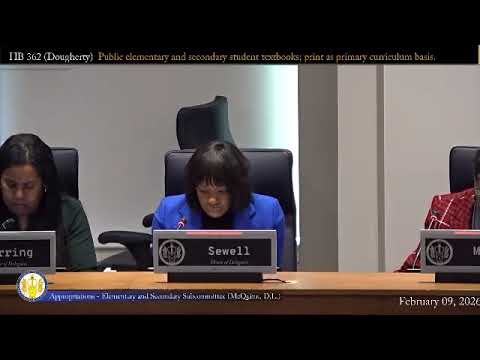
- House Bill 3 62: Establishes a printed textbook pilot to promote printed textbooks and high‑quality instructional materials, with grants for up to 10 school divisions and annual reporting; motion to continue to 2027 carried by voice vote.
- House Bill 4 12: Would have charged the joint subcommittee to study best practices for needs‑based school board budgets with a November 1, 2026 deadline; Delegate Sewell moved to table the bill and the clerk announced the bill was tabled (announced tally in transcript: "7 to 0").
- House Bill 5 92: Committee substitute permits school divisions to provide staff wearable panic alarm systems (removed the original grant program); substitute adopted and reported (clerk announced "7 to 0").
- House Bill 6 70: Substitute ensures labor and employment protections apply to public‑sector employees, including school division employees; substitute adopted and reported — the transcript announces a tally shown as "7 5 to 2" (garbled/unclear in the record).
- House Bill 12 78: Requires school division language access plans; committee substitute removed a Department of Education oversight/data‑collection provision and eliminated the fiscal impact; substitute reported (transcript shows conflicting tallies: 'Report with a substitute 5 to 0' and elsewhere '5 to 2').
- House Bill 13 67: Requires the Department of Education to collect data on expenditures for English learner education and post it online; a committee amendment removed a final sentence on future funding recommendations; the bill was reported with amendment (transcript tally garbled as '5 2 2').
- House Bill 14 70: Would require the Department of Education to collect local school division health insurance premium data to inform SOQ calculations; a member moved to 'gently table' the bill citing narrow scope and existing local disclosures; clerk announced the bill was laid on the table (transcript tally unclear and recorded as '70 0').
- House Bill 1 95: Adds eligible uses of at‑risk add‑on funds to support student physical and mental health, including specified licensed nursing positions; public testimony in favor from Catherine Haines (Virginia Interfaith Center for Public Policy) and Jeremy Bennett (Virginia Association of Counties); the subcommittee reported the bill but the transcript contains inconsistent roll‑call tallies (see individual bill notes).
Several committee actions were decided by voice vote or by recorded roll calls. The transcript frequently records results but does not include member‑by‑member roll‑call lists in the excerpt provided; in a few places the announced tallies are garbled or inconsistent in the record. The transcript does not indicate any formal opposition that changed outcomes for reported bills.
The committee adjourned after reporting these matters; next procedural steps for each bill (committee of jurisdiction, floor referral, or scheduling) are not stated in the transcript.