Virginia subcommittee advances package of data-center bills amid calls to condition exemptions on clean-energy steps
Loading...
Summary
The House Finance subcommittee heard six data-center bills and extensive public testimony before moving the measures to the full committee; lawmakers debated requiring upgrades to backup generators, dedicating new local revenue to rooftop solar and car-tax relief, and increasing transparency about tax exemptions.
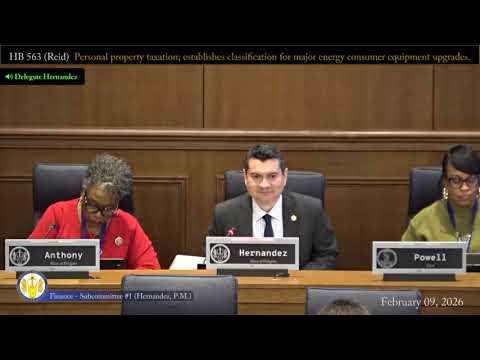
The House Finance subcommittee on Tuesday advanced a bundle of bills targeting the data-center industry after patrons presented measures addressing emissions, local revenue sharing, transparency and conservation funding, and after an extended public-comment period.
The subcommittee moved the six bills "by" for the day and sent them to the full committee for February 11 consideration. Patrons included Delegate Reid (two data-center bills: HB 563 and HB 1132), Delegate Krizick (HB 641), Delegate Sullivan (HB 897), and Delegate Anderson (HB 784).
Delegate Reid told the subcommittee HB 563 would allow localities to use local funds to incentivize data centers to replace aging diesel backup generators with cleaner systems. "That reduces the emissions by 90%," he said, describing the upgrade from a Tier 2 generator to Tier 2 with SCR or a Tier 4 equivalent. Reid said HB 563 was permissive and has no state fiscal impact.
Reid also presented HB 1132, which would set a baseline of local data-center revenue as of July 1, 2026, for jurisdictions with 20 or more data centers and direct 30% of any new revenue above that baseline to specified purposes. "The first 15% would be used to fund residential rooftop solar and battery storage in the locality where the revenue is generated," Reid said, adding the next 15% would be used to reduce that locality's car tax and the remaining 70% would remain for local discretion.
Supporters and opponents pressed the panel on definitions and consequences. Members asked whether the 20-facility threshold would refer to building count or DEQ permits; Reid cited Northern Virginia Regional Commission data and noted campuses sometimes compress multiple facilities into a smaller number of DEQ permits. Uber Chair Watts asked whether covered localities would be compelled to follow the allocation; Reid confirmed the bill would direct the covered localities rather than merely offer a permissive option.
Environmental groups and clean-energy advocates favored conditioning the tax exemption for data centers. Nate Benferrado of the Southern Environmental Law Center testified in favor of HB 897, saying, "It is critical that we make some changes to this tax incentive." Members of the Virginia League of Conservation Voters, Appalachian Voices, the Nature Conservancy and others similarly urged tighter standards and use of revenue for conservation and community benefits.
Industry representatives urged caution on tight clean-energy mandates and on disclosure of taxpayer-specific data. Nicole Riley of the Data Center Coalition said the sector supports negotiations with sponsors but warned some language "goes beyond JLARC's recommendations" and may impose clean-energy standards more aggressive than utilities currently must meet, raising practical permitting and affordability concerns.
Delegate Anderson's HB 784 would require the Department of Taxation to publish an annual report that lists data-center operators claiming sales-and-use tax exemptions, the total exemptions claimed, and whether recipients met agreed job and investment goals. Supporters described the change as needed oversight; industry groups warned of statutory confidentiality limits on taxpayer data but expressed willingness to work on a path to transparency.
After the presentations and more than an hour of testimony from trade groups, labor unions, conservation organizations and local governments, the subcommittee voted by voice to move the six data-center bills to the full committee on Feb. 11 for further consideration.
The next step for these measures is committee action in the full House Finance Committee, where negotiators indicated some provisions remain under active discussion. The subcommittee record shows ongoing talks between patrons and industry representatives to refine compliance timelines, definitions of covered facilities and permit-based thresholds.