Committee advances bill setting accountability standards for private schools that accept federal voucher funds amid constitutional debate
Loading...
Summary
The House education committee voted to report HB 359 (as substituted) to appropriations after heated testimony from private-school groups raising First Amendment and establishment-clause concerns and supporters urging safeguards for quality if federal voucher dollars flow into Virginia.
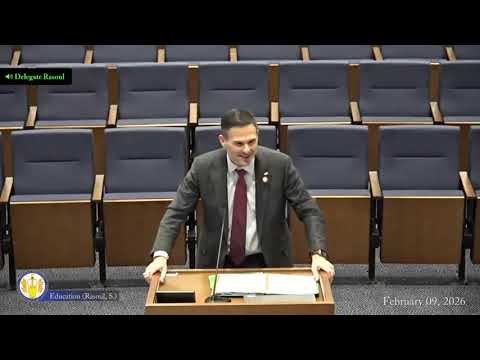
Delegate Doug Helmer presented House Bill 3 59 (substitute), which would require private schools that accept state- or federally-backed scholarship or voucher funds to meet certain accountability standards similar to public schools when public money is involved. Helmer said the measure aims to protect students, consumers and taxpayers by ensuring privately operated programs accepting public funds meet standards of excellence while allowing religious instruction to continue outside the conditions tied to public dollars.
Supporters such as Chad Stewart of the Virginia Education Association said the substitute narrowly addresses potential federal voucher programs and excludes existing state scholarship tax-credit programs; he called the measure an important accountability safeguard. Opponents — including Dan Zacharias of the Old Dominion Association of Church Schools and other faith-based school leaders — argued the substitute violates separation of church and state and that some funding counted as "public" in the bill is private charity or tax-credit-driven.
Michael Huffman, introduced as executive director and constitutional law professor with the Virginia Assembly of Independent Baptist organizations, told the committee he believes HB 359 raises at least three constitutional concerns: creating classes by conditioning public tuition assistance on religious practice, violating the Free Exercise Clause by conditioning benefits on religious behavior, and running afoul of the Establishment Clause. He cited recent U.S. Supreme Court decisions mentioned in testimony and warned of litigation risk.
Several private-school leaders and parents said the bill would force some longstanding schools to opt out of voucher programs or change missions, potentially restricting access for low-income families who use scholarship programs to afford private education. Proponents said the substitute is designed to preserve the status quo while setting minimum accountability if federal vouchers enter the state.
After extended public testimony and exchanges with members, Delegate Simons moved to report HB 3 59 as substituted and refer it to appropriations; the motion carried with a recorded vote of 12 to 6. Committee members signaled that constitutional concerns raised in testimony would be part of appropriations and counsel review.