House education committee advances SOL testing overhaul, sends omnibus bill to appropriations
Loading...
Summary
A House education subcommittee voted to report an omnibus Standards of Learning testing bill and related measures to appropriations after patrons and education groups described changes to testing timing, alternative assessments and protections for special education students.
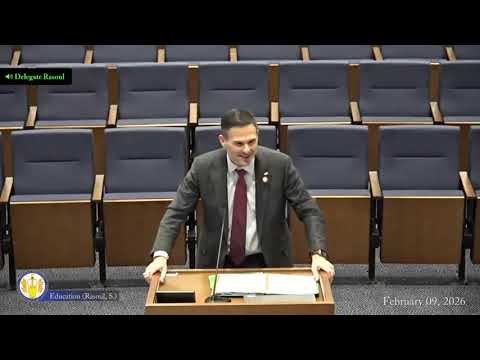
Delegate Doug Helmer introduced House Bill 299 as a substitute omnibus addressing Virginia’s Standards of Learning (SOL) testing, saying the measure moves tests later in the year, adds flexibility to a two-week testing window, delays implementing a 10% grade weight until improved assessments exist, clarifies exemptions for AP/CLEP/IB, and includes protections for special education students. “We want high standards for our children,” Helmer said, describing the bill as a product of work from last year and follow-up with stakeholders.
Advocacy and education groups told the committee they support the approach. Chad Seward of the Virginia Education Association said the technical changes make implementation more manageable for schools. Mike Asip of the Virginia Council of Administrators of Special Education praised provisions to avoid penalizing special education students, noting the 10% penalty could risk a student’s course completion. Alan Seibert of Runningsley Public Schools, testifying remotely, said improvements are necessary as the state moves to modernize its assessment system.
Committee members questioned timing, retake logistics and whether the substitute preserves funding formulas tied to SOLs. Helmer and other patrons said the substitute maintains retake opportunities and grants explicit flexibility to address seniors, transfer students and cases where instruction does not align neatly with year-end testing. The substitute also preserves a 100-point grading scale for clarity when discussing cut scores.
The committee voted to report HB 299 (as substituted) and refer it to the House Appropriations Committee for further work; the clerk recorded the vote as 16 in favor and 2 opposed. Related bills discussed alongside HB 299 included HB 189 (which would repeal the 10% minimum grade requirement) and HB 1410 (a narrowly drawn assessment process change for students with disabilities); the committee reported HB 189 as amended and carried HB 1410 over under Rule 22 to the next session.
The committee’s next step is appropriations, where fiscal and implementation details will be further examined.