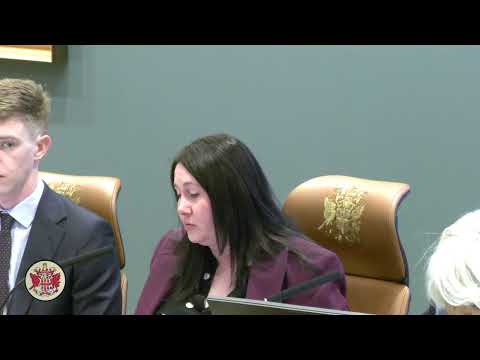
Virginia Senate subcommittee advances multiple education measures, carries several bills for fiscal review
Loading...
Summary
A Virginia Senate education subcommittee on Feb. 10 advanced or adopted substitutes for several K–12 measures and carried fiscal-impact bills — including a school psychologist incentive, an early-childhood mental-health pilot, and student-data protections for nonprofit partners — to joint K–12 funding review for budgetary analysis.
Madam Chair opened the Senate education subcommittee meeting in Richmond by noting the docket was mostly education bills with fiscal impacts and asked members to give brief summaries of measures already heard elsewhere.
Sen. Mark Heisz presented a bill to extend the national certification incentive program to school psychologists, arguing the Commonwealth faces a growing shortage and large caseloads: “The Department of Education recommends 1 psychologist per 500 students, but the current ratio is 1 to 1,240,” he said, and described proposed grants consisting of a $5,000 initial award and $2,500 annual renewals tied to National Association of School Psychologists certification. Committee members voiced concern about the fiscal pressure and, by motion, agreed to carry the bill over and refer it to the joint K–12 funding subcommittee for further budget review.
Committee members and sponsors also discussed folding education-related topics about juvenile detention into a broader planning study (SB468). One member urged that the planning study examine student–teacher ratios and the locations of detention facilities; the committee agreed to incorporate the detention-education language into the planning study and carry the matter over.
The panel adopted committee substitutes and reported or recommended reporting for several bills drawn from House or staff drafts. Notable actions included adoption of a committee substitute and reporting for SB3, a cost-sharing pilot that would use state matching funds to incentivize employer contributions toward employee child-care costs; the substitute requires annual reports on the pilot and ties family contribution policy to the Appropriation Act. Sponsors argued the approach would increase affordability while leveraging existing delivery systems.
The committee also advanced proposals to give the autism advisory body a permanent structure (SB280) by moving it to a commission staffed by the Department of Behavioral Health and Developmental Services, and it carried SB284 (a four-year plan to move Virginia toward the national average for teacher pay) to the joint K–12 funding subcommittee for budget consideration.
Sen. Stanley presented SB259, which would establish an early childhood mental health consultation pilot administered by DBHDS and EdHealth to reduce preschool expulsions and improve classroom outcomes. Sponsors said research from other states shows such pilots can reduce expulsions by up to 50 percent; after discussion of fiscal impacts, members agreed to carry the bill over to pursue one or two pilots in the upcoming budget.
On student data and nonprofit partners, the committee agreed to a substitute for SB190 that creates a statutory framework requiring certification, privacy policies, FERPA-aligned procedures, background checks, parental consent before sharing personal student information, and prohibitions on targeted advertising by nonprofit student-support agencies. Staff said the substitute relies on existing departmental authority and is intended to mitigate risk and standardize accountability; members asked staff to confirm any fiscal impact before full committee consideration, and the bill was carried over to the main committee.
Several other measures had substitutes adopted or were recommended for reporting with limited floor debate, including bills expanding allowable uses of at-risk pass-through funds to hire licensed practical nurses (SB33), statutory placement of certain grant programs with a maintenance-of-effort requirement (SB90), timing and reporting-date adjustments for a teacher-licensure work group (SB450), and bills addressing alternative graduation pathways, language access for English-learners, protections for special-education students should federal guidance change, and school-meal expansion. Committee action on many of these items was by voice vote ('aye'), and where the fiscal effect was unclear members routinely moved to carry bills for additional budgetary review.
Votes at a glance - SB469 (school psychologist incentive): Motion to carry over and refer to joint K–12 funding subcommittee — carried (voice vote: aye). - SB468 (juvenile detention planning/study): Sponsor suggested folding detention education language into SB468; committee agreed to roll language into SB468 and carry over. - SB3 (child-care cost-sharing pilot): Committee substitute adopted and bill reported (voice vote: aye). - SB280 (autism advisory council → commission): Committee substitute adopted and bill reported (voice vote: aye). - SB284 (teacher pay to national average): Carried over to joint K–12 funding subcommittee (voice vote: aye). - SB259 (early childhood mental health consultation pilot): Carried over to pursue pilots in the budget (voice vote: aye). - SB190 (nonprofit student-support agencies/data protections): Committee substitute agreed to; carried over to full committee for further review. - Multiple other bills and substitutes (SB33, SB90, SB125, child-welfare substitute, SB450, SB147, SB491, SB678, SB685, SP4): Substitutes adopted, reported, or carried over as noted in the timeline; most actions were voice votes and several items were moved for additional fiscal scrutiny.
What happens next Several bills with potential fiscal impact were referred to the joint K–12 funding subcommittee or carried to full committee for further budget analysis; sponsors and staff said they will provide additional fiscal details where needed. The subcommittee concluded its docket and the broadcast ended.