Get Full Government Meeting Transcripts, Videos, & Alerts Forever!
Get email alerts on the Historic Preservation topic
No spam. Unsubscribe anytime.
Kennesaw HPC reviews updated historic design standards, considers shrinking and consolidating district boundaries
Summary
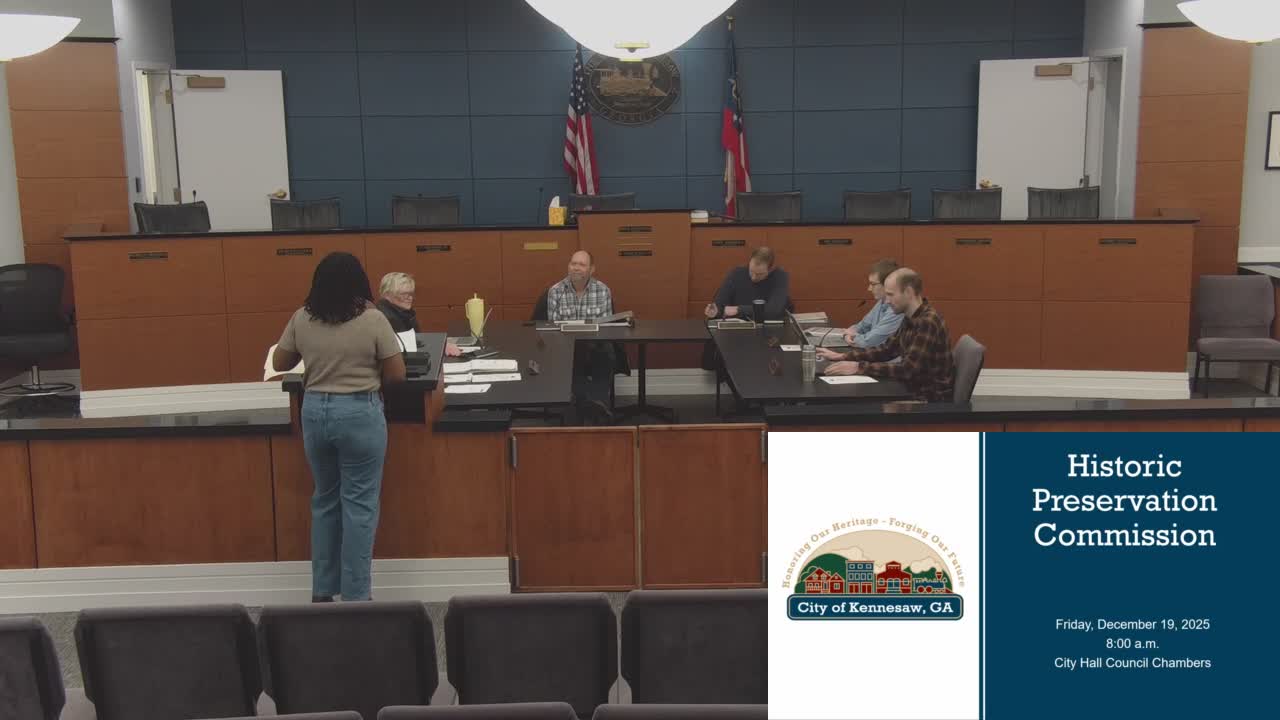
At a Dec. 19 work session, the Kennesaw Historic Preservation Commission reviewed consultant-recommended edits to the city's historic design standards and preliminary survey results from KSU and New South, debated removing HardiePlank from permitted materials for rehabilitation, and discussed a phased public outreach and adoption process.
The Kennesaw Historic Preservation Commission held a work session on Dec. 19 to review consultant recommendations for updated historic design standards and a preliminary revision of the city's historic-district map. Staff said the updates consolidate prior recommendations (Ethos, New South) and reflect a Kennesaw State University (KSU) survey that identified remaining historic properties inside the existing boundaries.
Why it mattered: Commissioners discussed options to reduce the number of separate historic-district polygons, make district boundaries more contiguous along arterial roads such as Main and Cherokee streets, and limit the burden of historic-design review on properties that do not contribute to historic character. Staff said consolidating districts could make the rules easier to interpret for residents and design professionals; commissioners weighed that against potential loss of parcel-level recognition for some older properties.
Staff (Chanel) told the commission the KSU survey shows many former contributing parcels have been demolished or replaced, leaving "hashed areas" with the surviving historic properties. Consultants recommended either consolidating multiple subdistricts into a single, clearer historic district or, alternatively, using parcel-specific local landmark designations for individual resources. "There are multitudes of options," staff said, adding the goal is to "retain the historic characteristic that we love about Kennesaw" while reducing undue burden on noncontributing homeowners.
Materials and rehabilitation: One specific technical change drew extensive discussion. Ethos recommended removing Hardie/Hardiplank (cementitious siding products) from the list of permitted materials for rehabilitation of historic buildings and limiting their use to new construction or additions. "Remove this as a permitted material on historic buildings," staff quoted Ethos's recommendation. Commissioners noted the practical trade-offs: wood siding is historically appropriate but can present high restoration costs, while cementitious products are often chosen as durable, lower-cost alternatives. Several commissioners said rehabilitation of existing wood siding should generally favor matching historic materials, and that exceptions or appeal pathways to mayor and council should remain available for unusual hardship cases.
Application process and clarity: Commissioners debated whether Certificate of Appropriateness (COA) submittal requirements should live in the design standards or be moved to COA application forms to allow administrative updates. Staff explained keeping requirements inside an adopted ordinance or standard triggers a public-notice process for any change, whereas application forms can be updated administratively. Commissioners suggested compromise approaches (e.g., a concise summary in the standards with details on the application form) to balance transparency and administrative flexibility.
Implementation and outreach: Staff proposed a phased approach: finalize an initial set of clarifications and "cleanup" edits, hold multiple town-hall meetings to present the proposed changes to residents, then return revised standards and any boundary recommendations to the HPC for formal review before forwarding to mayor and council for adoption. Staff also noted the city's comprehensive-plan rewrite scheduled for 2027 could influence the timing and scope of changes. Town halls are expected to be scheduled in multiple sessions, with at least one midweek offering to maximize access.
Funding and survey work: Staff said the city's completion of the KSU survey moved it from a CLG category 1 to category 2, which makes the city eligible for additional preservation funding that could be used for rehabilitation assistance. Staff also said they will consolidate New South reconnaissance (2018'19) and the KSU update into the documentation packet that will inform the revised design standards and any proposed boundary changes.
Administrative items and next steps: Staff reported one administrative COA for a storefront sign at 2893 North Main Street was approved on Dec. 2 and the sign permit issued; installation is expected shortly. The commission also voted to approve minutes from the Nov. 21 meeting and the financial report (available balance $23,398) by unanimous roll call. Staff said they are actively recruiting applicants to fill a vacant board position.
The commission did not take formal votes on the draft design standards at this session; staff will schedule town halls and return a revised package for formal HPC recommendations and subsequent mayor-and-council consideration.