Hilliard committee hears proposed Big Darby Accord amendments stressing monitoring, clustered growth and new revenue tools
Loading...
Summary
MKSK principal Chris Herman briefed Hilliard’s Committee of the Whole on a draft amendment to the Big Darby Accord proposing a three-year rotating water-quality monitoring program, revised conservation tiers, a 25% revenue dedication to open space and reallocation of remaining development units toward areas served by sanitary sewer; council members pressed for more data and asked whether jurisdictions would pause new filings while monitoring is established.
Chris Herman, principal at MKSK, told the Hilliard City Council Committee of the Whole on Feb. 9 that a draft amendment to the Big Darby Accord would add a comprehensive, rotating water-quality monitoring program, revise conservation-area tiers and change revenue mechanisms to better fund land protection and adaptive management.
Herman said the 2006 Accord helped preserve open space and spur restoration—he cited nearly 3,500 acres of new open space preserved and about 6,147 housing units built since 2007—but it never established the long-term, consistent water-quality monitoring the panel originally intended. "We must figure out how to fund it, and we must get it going," Herman said, urging jurisdictions to adopt a standardized approach and shared oversight.
Why it matters: the amendment aims to use current satellite and GIS mapping to protect the most sensitive lands, require stricter on-site protections and create a monitoring backbone that would allow data-driven, adaptive changes to Accord requirements. The draft keeps the 20,000 equivalent residential unit (ERU) cap from 2006 but seeks to reallocate the remaining roughly 13,000 units to locations where centralized sanitary sewer can be extended, notably the eastern edge near Hilliard and Columbus.
Key proposals and features in the draft
- Water-quality monitoring: an annual sampling program on a three-year rotating schedule across sub-tributaries, with consistent data points and public annual reports. Herman said the monitoring would be funded through a jurisdictional formula proposed in the amendment (initially population-based) but open to negotiation.
- Revenue changes: the draft expands allowable revenue uses, reduces reliance on TIFs and new community authorities and dedicates 25% of collected revenue to open-space acquisition. The plan also revisits the per-unit assessment that existed in the earlier framework (Herman said the figure was about $2,500 two decades ago) as part of revenue conversations.
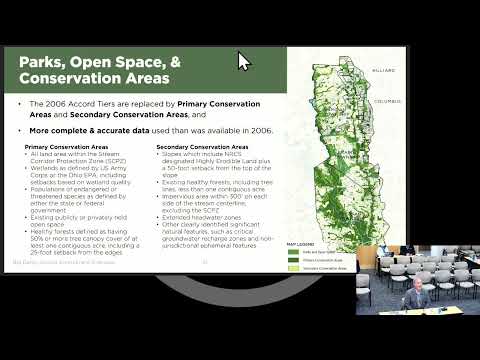
- Conservation and land-use: the amendment consolidates conservation tiers into primary (no development allowed) and secondary (preserve by default but subject to hardship review). It clarifies what qualifies as open space, allows developers to meet requirements by providing off-site primary or secondary land (with defined acreage multipliers), and requires on-site stream and wetland restoration when applicable. The draft also includes a 300-foot buffer requirement and calls for "no effective impervious area"—meaning new-development stormwater should be intercepted and treated rather than discharged directly to streams.
- Site allocations and ERUs: the amendment retains the 20,000 ERU limit established in 2006 but proposes reallocating remaining units to areas with sewer access to avoid expansion onto septic systems. Herman said clustering development near sanitary sewer can reduce sprawl and impervious surface when combined with best management practices (BMPs).
Council questions and remaining concerns
Council members pressed for more evidence before finalizing allocations. One councilmember asked whether watershed boundaries and sensitivity determinations were robust; Herman replied that the draft uses new tree-stand, headwaters and drainage mapping that were not available in 2006. Another asked why the jurisdictions should not wait for the IPS phase 2 study (expected this year) before reallocating units; Herman said the IPS adds useful context but primarily analyzes historic data and does not substitute for the kind of new, consistent monitoring the amendment proposes.
An unidentified councilmember asked whether any jurisdiction would impose a moratorium on development while better data were gathered. Herman said Columbus has expressed concern that not allowing filings risks an effective moratorium and that the political pressure on Columbus could push it to accept higher-density proposals if it can secure BMPs. President Cole asked if Herman had evidence the Hell Branch tributary could support the proposed development levels; Herman said he could not point to comprehensive data yet and stressed that the proposed monitoring and adaptive-management framework are designed to fill that gap.
Next steps
Herman said BDART (the Big Darby Accord Review Team) expects to produce a public draft in March, hold public workshops and aim for jurisdictions to consider final drafts and hearings in April 2026. The Committee offered feedback and questions for inclusion in BDART’s revisions. No formal action or vote on the amendment occurred at the meeting; the only formal motion recorded was to adjourn. The Committee adjourned after the presentation and Q&A.
Sources and attributions
The article draws on direct remarks by Chris Herman of MKSK during the Feb. 9 Committee of the Whole meeting and on exchanges with council members recorded in the meeting transcript.