
Alabama Supreme Court weighs scope of reporter's shield in New York Times defamation case
Get AI-powered insights, summaries, and transcripts
Subscribe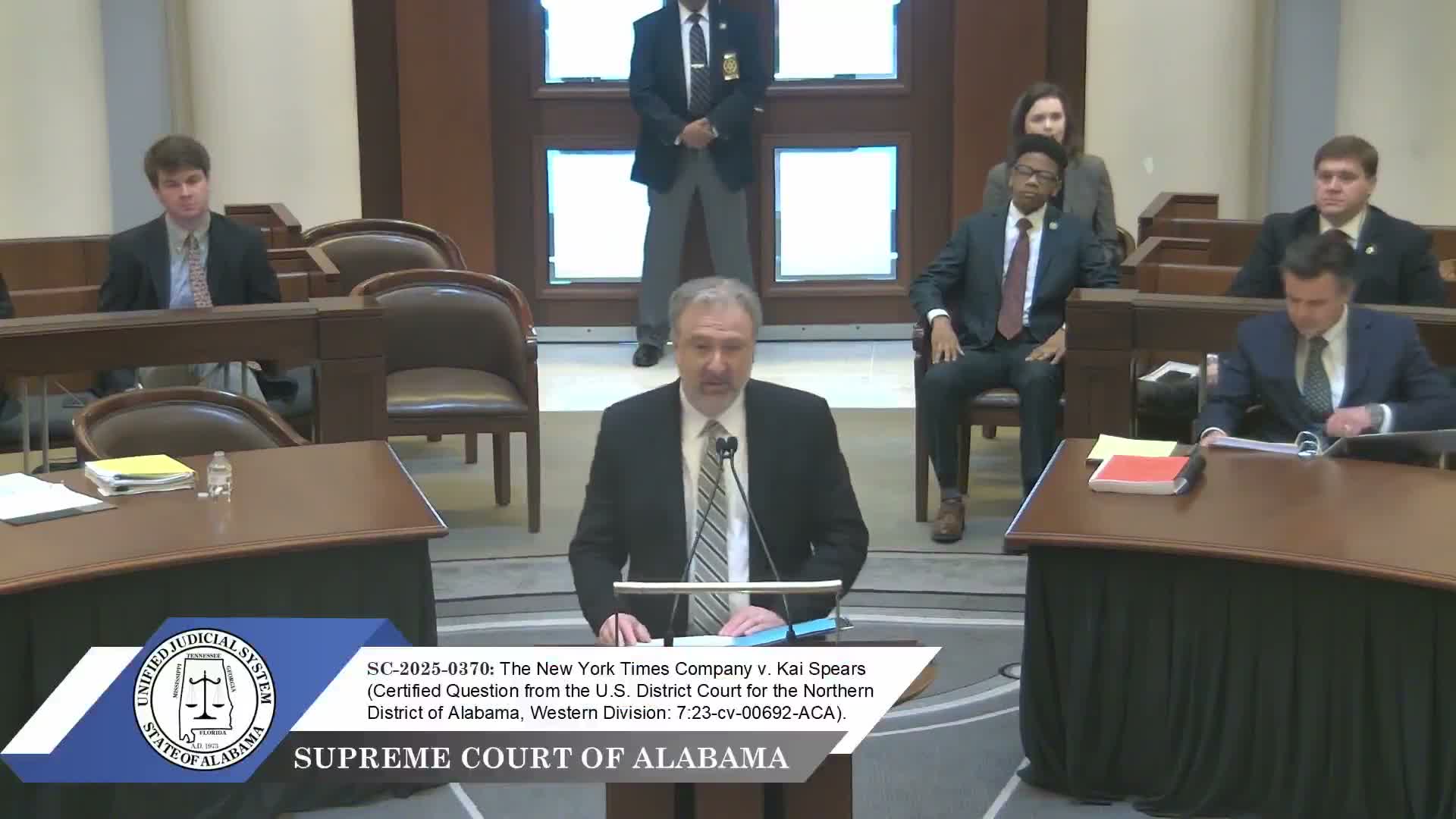
Summary
The state's high court heard argument on whether Alabama's reporter's shield protects only a source's identity (name) or also information that would reasonably identify a confidential source. Counsel for the Times urged a standard protecting information that reasonably identifies a source; the plaintiff's counsel emphasized the need to learn what the newspaper knew before publication.
MONTGOMERY, Ala. ' The Supreme Court of Alabama heard oral argument in SC20250370 over how broadly the state's reporter's shield applies, a dispute at the center of a defamation suit brought by Kai Spears against The New York Times Company.
Chad Bowman, counsel for The New York Times, told the court that "both certified questions today from the Northern District of Alabama relate to the interpretation of the same statute, Alabama's nearly century old reporter shield law," and urged the court to adopt a standard under which the shield protects information that would "reasonably identify" a confidential source. Bowman said the Times had asserted privilege over a narrow set of materials produced in discovery: "phone numbers from the reporter's call records, the meeting logistics that would reveal where the reporter met source A, photographs that contain visual cues about source A, or the information from the handwritten notes." He argued those items, even if not a name, could point to an individual and therefore be protected.
Matt Glover, counsel for Kai Spears, framed the case around what the newspaper knew and when. Glover told the court the article stated as fact six times that Spears "was in the car with a murder weapon" and said one anonymous source cited in the story later equivocated; he also said the Times had communication with a second, uncited source before publication who "told the Times that they were likely wrong." Glover said the plaintiff must be able to explore whether sources had firsthand knowledge and whether the Times took reasonable steps to corroborate the core assertions.
Justices probed practical consequences and testing standards for trial courts. Several asked whether a simple rule ' such as protecting only facially self-identifying information (for example, a name, phone number, email or address) ' would be administrable, or whether a "reasonably likely" or "highly likely" test should be announced to guide lower courts. Bowman and Glover both said the ultimate application would be fact-specific and for the trial judge to decide, with Bowman's proposal focusing on whether requested information "could reasonably lead to the identification of a source" and Glover urging limits to prevent the privilege from shielding facts that bear on a source's reliability.
The parties and justices discussed common procedural tools: privilege logs, in-camera review by judges, and the timing and scope of deposition objections. Bowman said trial judges routinely resolve such disputes and that in many cases a privilege log suffices, though narrow in-camera review could be necessary for close calls. Glover stressed that a defendant press for punitive damages must have access to information showing what the newspaper knew about the truth or falsity of the reported assertions.
Neither side asked the court to adopt a sweeping, categorical rule. Bowman emphasized precedent in other jurisdictions and argued for a standard that preserves confidential sourcing that courts have protected elsewhere; Glover emphasized the jury's need to assess reliability when a plaintiff seeks damages and fault.
After the argument the court took the certified questions under submission. The court did not announce a ruling from the bench and adjourned.
The case returns to the trial court in the Northern District of Alabama for further proceedings pending the Supreme Court's guidance on the statutory standard.