
Baltimore County commission finalizes framework for first CRRF community grants round, debates for‑profit eligibility and payment terms
Get AI-powered insights, summaries, and transcripts
Subscribe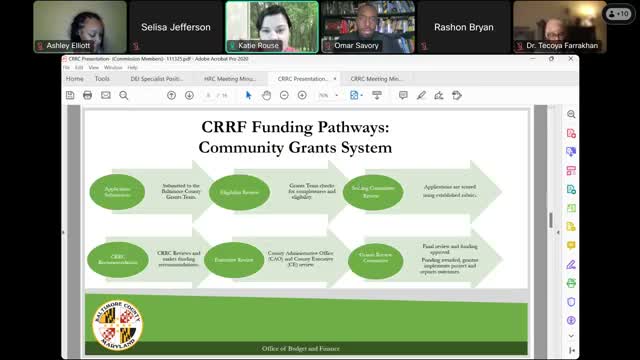
Summary
At a regular Baltimore County CRRC meeting commissioners reviewed the draft community grants RFP, approved key program parameters for an initial $2.5 million pilot, and debated eligibility for for‑profit applicants, a 50% cap on funding staff positions, and whether to allow partial upfront payments.
Baltimore County’s Community Resilience and Recovery Commission spent the bulk of its meeting reviewing a draft request for proposals (RFP) to launch the CRRF community grants program, with commissioners and county staff agreeing on a pilot approach but disagreeing over eligibility rules and payment structure.
Chair Katie opened the conversation by outlining two pathways for using the fund: a community grants program for eligible organizations and a separate county proposal pathway that the commission will review for alignment. “First things first is that we are going to finalize the way the application is written,” Katie said, describing a process in which county staff make an initial technical eligibility review and score applications, and only those above a 70‑point threshold advance to the commission for recommendation.
The county’s grants review administrator, Matt, described the administrative checks that follow commission recommendations and the county’s role in execution. “It goes over to the county council for what we call a negative approval process… If we don’t hear from you in 14 days, we’re gonna consider them moving forward,” he said, describing the 14‑day notice to the council and the encumbrance practice for awarded funds.
Staff and the chair proposed parameters for a first funding round intended as a pilot: dispersing about $2.5 million this year in one‑year grants to start, using the process to learn how best to manage awards over time. The draft RFP as discussed calls for applicants to describe measurable outcomes (residents or households served and program‑specific targets), and to use accessible frameworks such as SMART goals when proposing performance metrics.
The proposed budget rules discussed included a 10% match requirement (cash or in‑kind) and a limit that CRRF grants may not fund more than 50% of any single staff position. The chair said those restrictions aim to promote sustainability and avoid fully funding positions where there is no plan for long‑term support.
Several commissioners urged flexibility on payment structure and term length. One commissioner warned that a one‑year term may be insufficient for larger projects and asked whether renewal or multiyear options could be considered in future rounds. The chair and grant staff said the preference was to pilot single‑year awards and use the first year to build monitoring capacity before committing to multiyear agreements; other commissioners urged including language in the RFP clarifying that renewals are not guaranteed but that high‑performing grantees would be prioritized for future consideration.
A major point of contention centered on eligibility for for‑profit organizations, the proposed salary cap and upfront payments. John (speaker 9), representing a community organization, strongly objected to allowing private for‑profit companies to apply for the funds, saying it risks directing money away from small community groups: “These funds are being made available to private for profit companies. That’s a nonstarter with me,” he said, also arguing the 50% cap on staff funding would disadvantage small organizations that cannot front the remaining payroll. John urged at least partial upfront payments, citing prior opioid‑abatement grants that allowed a 25% upfront disbursement for capital purchases.
County staff and other commissioners offered compromise language and options. Matt said the county can structure agreements with benchmarks, partial upfront percentages, or reimbursement models depending on a grantee’s situation and the county’s monitoring needs. He suggested that executive compensation limits could be separate from program‑level staff funding so program workers could be funded at higher percentages when necessary.
Commissioners agreed on near‑term next steps: members were asked to submit written feedback on the draft RFP by the proposed deadline (the Friday the 21st mentioned in the meeting), with staff (Ashley) collecting edits and presenting consolidated comments to county grant leads Gabby and Matt. “You can send it back to me, and then I’ll gather the feedback, put it together, and then present it to Matt and Gabby,” Ashley said.
The commission also discussed an expanded role for itself in reviewing county‑initiated proposals so the commission can see the full picture of how the fund is used and avoid overconcentrating investments in a single priority area. The group emphasized technical assistance and outreach to help microbusinesses and smaller nonprofits apply; staff noted partnerships with Maryland Nonprofits and the Maryland Small Business Development Center to host community technical assistance sessions.
The chair said the commission aims to finalize RFP language by email vote in December so the grant announcement can be launched in January, with outreach and community meetings to follow. The meeting ended with action items for commissioners to review the RFP attachment and return edits to staff.
Provenance: discussion of grant pathways and RFP parameters began with the chair’s presentation of disbursement pathways and grant application steps and continued through public debate on eligibility and payment terms; the transcript records the opening of the grants discussion at SEG 282 and substantive debate through SEG 1792.
Next steps: commissioners will submit written edits on the RFP by the stated deadline, staff will compile feedback and present consolidated revisions to county grant staff, and the commission expects to vote by email so the RFP can be released in January.