Get Full Government Meeting Transcripts, Videos, & Alerts Forever!
Get email alerts on the Budget topic
No spam. Unsubscribe anytime.
Greene County explains 'vacancy savings' strategy to fund services
Summary
Budget staff and two discussants outlined Greene County process of budgeting projected payroll savings from unfilled positions to free funds for purchases and services, describing mechanics, risks (overtime, retirement payouts) and safeguards like biweekly scorecards and hold periods.
Speaker 1 (unidentified speaker) said Greene County treats payroll vacancy as a strategic source of funds rather than a sign to cut jobs, noting, "Almost 80% of our general fund goes to personnel costs." The speakers said the county counts projected savings from unfilled positions as spendable revenue to finance equipment, software and other priorities.
The discussion, which did not list participant names or a meeting date in the transcript, explained how vacancy savings are calculated: when an employee leaves there is a gap before a new hire starts and the budgeted salary for that gap becomes a source of savings. Speaker 3 gave the 2026 headcount as 1,316 funded positions and said general fund personnel costs total $73,700,000, about 79% of the fund.
Speakers described two ways savings accrue. First, an empty chair yields direct savings while it remains unfilled. Second, the "step-differential" can add savings when a long-tenured employee at a high pay step is replaced by a lower-step new hire. Speaker 3 illustrated: if a $50,000 position sits empty for a month, the county saves roughly $4,000.
Officials recounted a 2014 budget crisis and a 2015 policy pivot that created a formal vacancy line item. In its first year the county budgeted about $467,000 in expected vacancy savings and transferred that amount from personnel to spendable funds to meet capital and operating requests that otherwise would have been denied.
Speakers acknowledged risks. Overestimating savings can create a budget hole; to manage that risk Greene County uses contingency reserves and keeps a small emergency fund. They stressed the administrative effort required: a position-master workbook that tracks each of ~1,300 positions from a mid-July snapshot through final budget adoption and biweekly scorecards comparing promised versus actual net vacancy.
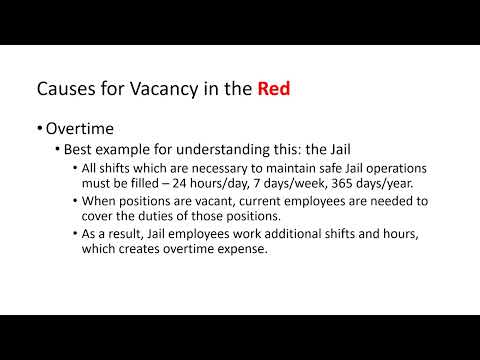
Several operational caveats followed. The jail is a frequent driver of negative vacancy numbers because corrections posts cannot be left unfilled; overtime to cover shifts typically erodes any vacancy savings for that department. A 2026 calendar quirk (an extra paid holiday early in the year) was cited as an example that pushed the jail into a deep red vacancy position without indicating mismanagement.
Speakers also described retirement spikes: large payout checks for accrued leave can negate vacancy savings unless the county enforces a hold period that delays replacing the retiree for several weeks so the department can accumulate funds to pay the payout. The hold period is implemented to keep the overall budget neutral but is acknowledged to strain department operations in the short term.
Finally, the presenters contrasted "on-book" vacancy (a department-level negative line item) with "off-book" central estimates used by the budget office and commission to gauge countywide spending power. They argued that tight, transparent tracking down to individual hires and dates helps department heads and commissioners reconcile numbers and build trust in the estimates.
No formal motions or votes were recorded in the transcript. The session ended with an emphasis on transparency and the claim that vacancy accounting, properly managed, can convert unfilled positions into funds for services and capital needs.