
Johnson County supervisors advance FY2027 decision packages, debate $8 million jail project line
Get AI-powered insights, summaries, and transcripts
Subscribe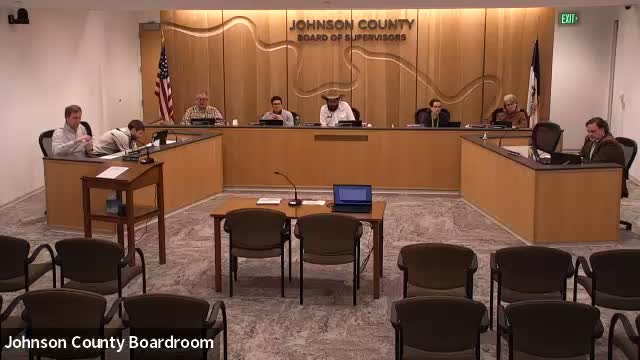
Summary
Supervisors approved a slate of FY2027 decision-package items including public-health and fleet replacements, added $200,000 for the Iowa Water Quality Monitoring Network and budgeted a sheriff mental-health liaison with net county cost of about $11,000; the board also debated whether to include an $8 million early-appropriation line for a proposed jail project. (4–5 minutes read)
The Johnson County Board of Supervisors met Feb. 4 in a budget work session and advanced multiple FY2027 decision packages while reserving additional review on several large items, most notably a proposed $8 million fiscal-year appropriation tied to a potential new jail project.
The board read and voted on a long list of decision packages across departments, approving emergency medical equipment, public-health software subscriptions, vehicle and fleet replacements, and capital maintenance items. Supervisors added $200,000 to the board’s decision packets for the Iowa Water Quality Monitoring Network, one-third of an identified $600,000 regional ask, and included a sheriff’s law-enforcement mental-health liaison position budgeted at $133,334 with projected revenue that reduces the county’s net cost to roughly $11,000.
Why it matters: the session folded dozens of discrete line items into the proposed FY2027 budget while bringing into sharper relief a set of larger policy choices — how much to spend up front on a possible bond-funded jail project, how to present grant-funded positions in the packet under a new Workday accounting structure, and how to manage volatility in the county’s health-insurance fund.
On the sheriff liaison, supervisors queried whether reimbursements would reduce the county share; the sheriff clarified the existing structure: "So right now ASO covers 75%. That remaining 25% is that split between the 3 of us," and staff said the county will budget the full salary and record expected reimbursements on the revenue side if and when they materialize.
The board heard from staff that the county’s employer-share health-insurance fund has experienced an unexpected cash burn; finance staff recommended restoring $2,000,000 to the fund to stabilize a target cash balance near $10,000,000.
Fleet and emergency response: the sheriff and fleet managers urged maintaining the current vehicle-replacement cadence, arguing that shrinking the fleet or doubling up cars would accelerate maintenance and reduce operational resilience. Dawn (fleet staff) told the board that sheriff vehicles were placed in a "needs immediate consideration" category after a review of maintenance costs and downtime.
Iowa Water Quality Monitoring Network: the board added a $200,000 allocation to support a three-county effort to deploy water-quality sensors; supervisors noted Polk County had already committed $200,000 and that the regional lead had raised funds via GoFundMe. The line passed in a roll call with supervisors expressing support while at least one member said they would prefer a smaller county contribution if the amount stayed at that level.
Jail project and the $8 million line: officials and the jail committee presented an $8,000,000 FY2027 line described in materials as "design for a new jail facility," which staff later recommended be labeled more broadly as "jail facility project costs" because the amount could include contractor or other project expenditures. Staff framed the figure as a conservative 10–15% assumption on a preliminary $80,000,000 project estimate and said it was intended as a worst-case planning number that can be amended later if the board chooses.
County attorney Rachel Zimmerman Smith cautioned the board to stay within the general-budget agenda when detailed project discussion began: "This is a little more than a general budget discussion we're having," she said, suggesting tabling deep project-level debate and reserving more specific votes for a focused agenda item. Several supervisors said they supported budgeting conservatively but asked for a clearer accounting of what portion of any early spending would be unrecoverable if voters rejected a bond.
What passed and next steps: the board recorded roll-call approvals for numerous equipment, software and personnel decision packages and asked staff to revise the live worksheet and circulate pages 10–11 of the state form so supervisors can see the fiscal impact of today’s changes. Chair and finance staff scheduled a Friday follow-up meeting to refine the packet; staff were asked to return updated worksheets before the next formal meeting on Feb. 5.
The work session closed with direction to (1) present clearer decision-package documentation showing gross and net costs under the new Workday coding, (2) provide a prioritized list of vehicle replacements and indicate which are "immediate" vs. "qualifies," and (3) prepare a more detailed accounting of the jail project costs — including the likely portion that would be "sunk" if voters deny the bond — prior to any final appropriation. The board adjourned after confirming the next meeting and assigning follow-up tasks to staff.